Security Hands-On-Training – Part 4

[Following part 3 where the  ASP.NET web site code was modified, part 4 will show different methods, techniques, and ways of manipulating the user input in order to control the logic of the application making the web application exploitable. ~Luis]

During the previous chapter the defenses that were in place in the test application were removed. To achieve this a  trial and error approach was used. While looking for SQL injection vulnerabilities, different methods, techniques, and ways of manipulating the user input were tried in order to see how the system reacted. This method allows us to learn and practice which defenses would need to be removed to allow a successful exploit.

The HelpDesk.aspx page is shown in the next figure. It simulates a helpdesk ticketing system where the user is allowed to input data into two fields. The “Station Number” and the “Problem Description”.
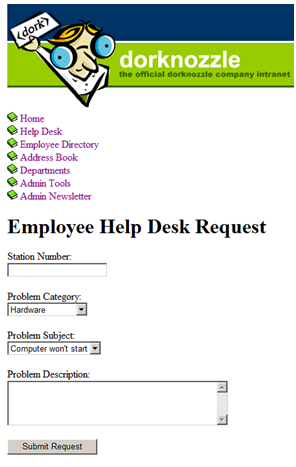
security-hot-fig9

When the user clicks on the “Submit Request” button, the web form takes the value and passes it to a SQL statement. This will happen without validation controls because they were removed in the previous post. Behind the scenes this page contains an INSERT SQL statement that will receive the user input and insert it into the database. The code block that allows this to happen is shown below.

security-hot-fig10

The database called “Dorknozzle” contains a table called “HelpDesk”. This is shown in the below figure. In the database there are several columns that are used to store the user input. During the trial and error method to discover a SQL injection point  it was found that input that is stored in the database as an integer could not be manipulated.  This applies to the “Station Number” field. However, the “Description” field uses the nvarchar type and allows up to 50 characters to be inserted.
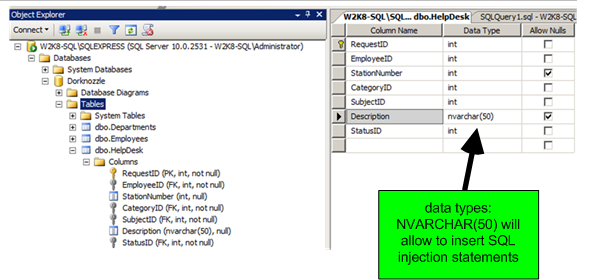
security-hot-fig11

With this in mind and with the defenses down the reader can start adding characters in the user input fields that would change the initial query logic and see how the system reacts. The first character to try is the single quote. When clicking the submit button the web application returns a SQL exception message. This happens because the error messages were enabled.

security-hot-fig12

This was exactly the objective. This SQL error message discloses that the statement submitted had an unmatched number of single quote characters. To further exploit it the reader would need a way to construct a statement in the input field that allowed to terminate the string and append the malicious SQL statement (OWASP,4). At this stage the debug functionality of Visual Studio Express was used. By introducing a break point in the code where the SQL statement is, the application execution could be controlled. Then the Web application was started in debug mode. In the HelpDesk page the character “A” and a single quote was inserted in the “Problem Description” field. When submitting the request the break point kicked in and the step into functionality was used to dig into what was happening. This allows us to verify exactly how the SQL statement was being constructed and executed by the database. The next figure shows these steps.
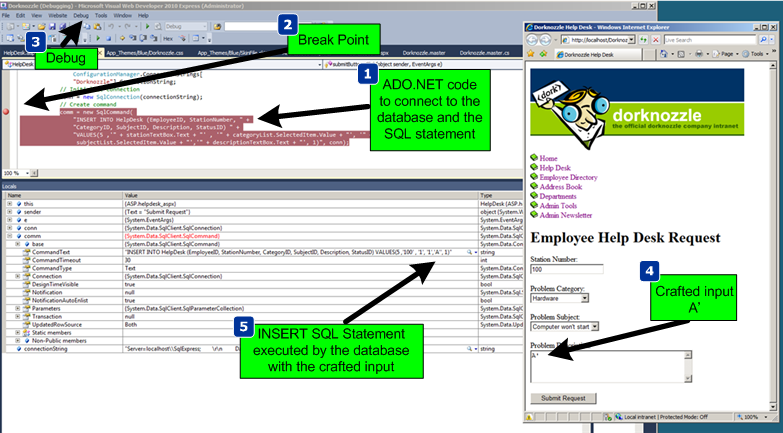
security-hot-fig13

The SQL statement that was being sent to the database was not well formed due to the crafted input which caused an odd number of single quote characters resulting in a SQL error. The below figure shows what the SQL statement looks like.
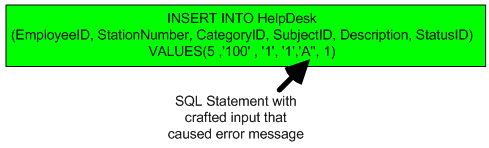
security-hot-fig14

Now it is just a manner of time to find the correct input that will create a well formed SQL statement and introduce the malicious SQL code. During this iterative process the reader can find that he could close the SQL statement by injecting the right number of values that the database is expecting. Then another statement could be inserted and this would be the injection point and the “–“ sequence (two dashes) can be used to ignore the rest of the statement. This SQL injection point is inside an INSERT statement. Because of this you couldn’t see the output of the injected query or any difference in the in the responses of the web application which increases the difficulty of the technique. Using a technique called Blind SQL injection, which was first introduced by Chris Anley in 2002, the reader  might use inference techniques to get the results (Clarke, 2012). For example, with this technique, SQL statements that analyze the response time can be used. One method is using the sleep function like WAITFOR DELAY ‘time’. Using this technique the reader could make the database wait and reveal if a statement was true or false. In the next figure is shown how the SQL statement would look like after having the evil payload inserted. This will result in the database to wait 5 seconds before producing the results.

security-hot-fig15

In addition to the previous example the following SQL statements could be used in the SQL injection point to understand how the database would react:

IF (1=1) WAIT FOR DELAY ‘0:0:5’ —
IF (1>2) WAIT FOR DELAY ‘0:0:5’ —

Then more advanced queries could be used to determine if the current user is part of the sysadmin role:

IF((SELECT (CASE WHEN (IS_SRVROLEMEMBER(‘sysadmin’)=1) THEN ‘1’ ELSE ‘0’ END))=’1′) WAITFOR DELAY ‘0:0:5’ –

This seems a rather tedious and slow process but this will be automated using well known SQL injection tools in the upcoming articles. These tools dramatically increase the efficiency of an attacker but also extend the attack population. One disadvantage of these powerful tools is that any inexperienced person can mount complex SQL injection attacks regardless the technique or the database technology (Clarke, 2012).

During this exercise the reader is able to learn about SQL, its inner working queries and how SQL statements are constructed. It should be clear now why is important to disable any error messages and  why it is important to sanitize all input. When the reader has a good understanding of the tools and techniques and can control the logic of the application the reader could also use SQL injection with serious consequences. Tools like SQLmap and SQLninja can be used to automate these techniques.

Even though the focus was on SQL injection the environment is ready for additional tests by reducing our defenses further. In the context of this web application the reader could introduce other vulnerabilities such as Cross-Site scripting (XSS), Cross-Site Request Forgery (CSRF) or introduce a broken authentication mechanism. Learning how to do this and understanding the mechanisms behind the scenes is a rewarding exercising. Likewise, learning the attack vectors, use the tools, taking the time to experiment with them and understand how they work will make one better equipped and skilled.


References:
OWASP. (4, September 13). Testing for sql injection (owasp-dv-005). Retrieved from https://www.owasp.org/index.php/Testing_for_SQL_Injection_(OWASP-DV-005)
Clarke, J. (2012). Sql injection attacks and defense, 2nd edition. Syngress.

Tagged , , , ,

Security Hands-On-Training – Part 3

[Following part 1 and part 2 where we built an infrastructure with different systems, below article will focus on the Web Stack and will show how the ASP.NET code has been modified in order to make the application less secure. This will allow us to understand the security mechanism enforced by the application in order to make it defenseless and practice our security tools and techniques! ~Luis]

Instead of modifying the secure test application, the reader could use an existing vulnerable web application. Likewise, the reader could use test sites that allow him to practice hacker techniques in a wide variety of security realms. Just chose one from Aman Hardikar’s awesome mind map with various penetration testing practice labs and vulnerable applications (Hardikar, 2013). But on the other hand, building an infrastructure with simple IT services such as directory services, messaging services and a web stack  will allow the reader to enhance the depth and breadth of its skills not only from a security perspective but also from a systems and networking viewpoint.

Also, It is valuable to be exposed to defense and offense. Through the process of creating this environment and then growing it at will, the reader can practice both sides. In this environment a simple and secure web application is created and then its defenses are reduced. For instance, while following the mentioned book to create an ASP.NET website the code uses strong protections against SQL Injection using parameterized queries, stored procedures and data validation controls (Posey, Barnett & Darie, 2011). To make the application less secure, the reader first has to understand the security techniques employed by this application. The same applies to other technologies. For example techniques that protect against malicious user input. Once the code is vulnerable, the reader can explore attack techniques.

After building the mentioned web application – the code is available for free on GitHub -, 4 steps are executed to make it vulnerable: First, a user account with system administration privileges is created. Second,  the SQL parameterized statements are replaced by dynamic SQL statements. Third, the code is changed to make the application disclose error information and finally, the data validation code is removed to avoid input sanitization based on type, length, format or range.

For step one, go into the SQL Management Studio on your database server and create a user with system administration privilege (sysadmin) as illustrated in the left side of the following figure.
security-hot-fig5

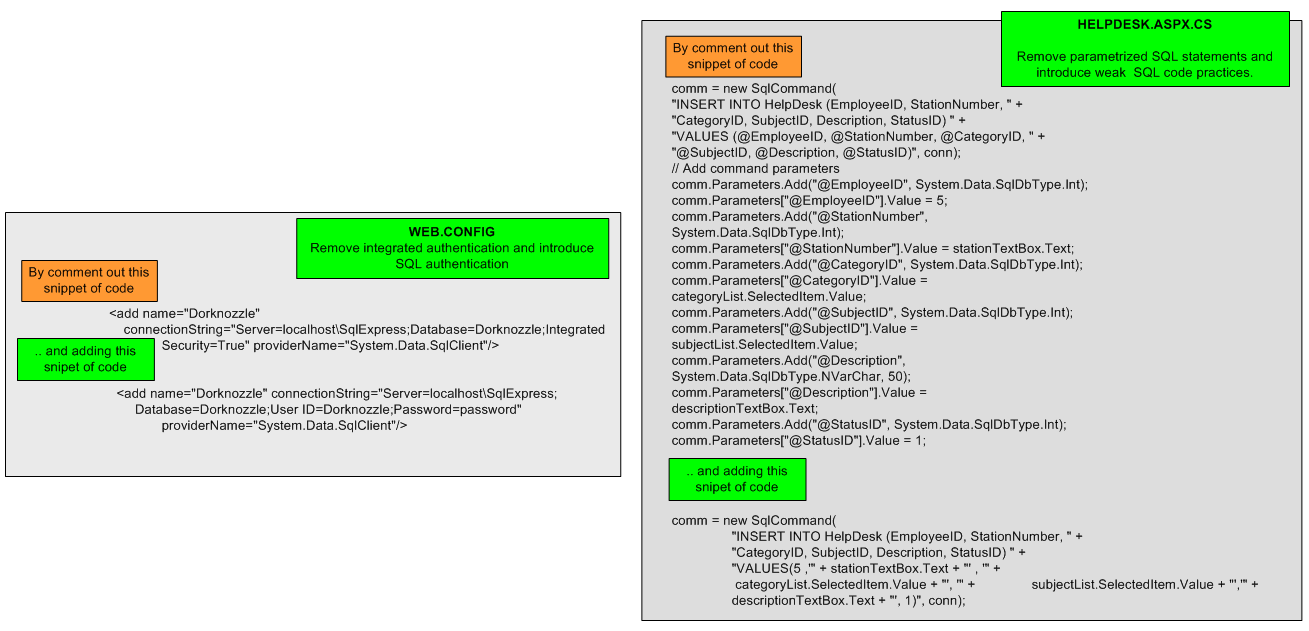
This user will be used to define a database connection using SQL authentication. Then start changing the .NET application code using Visual Web Developer 2010 Express. For reference the right side of previous figure shows how these code files look. Next, web.config is modified. The authentication mechanism used by the application to connect to the database will change from integrated authentication to SQL authentication as shown on the left side of below figure (Posey, Barnett & Darie, 2011).  After making the change make sure the application can be compiled and is working as expected. Next change HelpDesk.aspx.cs. Remove the block of code that contains the parameterized SQL statements and replace it with a dynamic SQL as shown in right side of the following figure.

security-hot-fig6

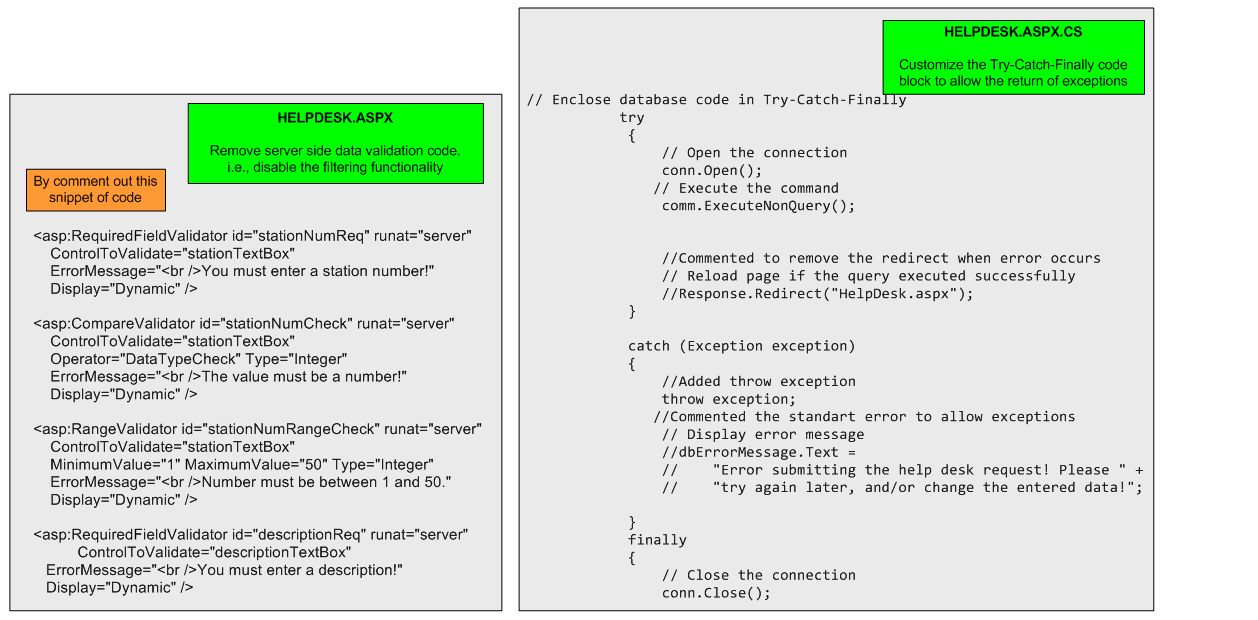
Following that, step three is to customize the Try-Catch-Finally code block in HelpDesk.aspx.cs as shown on the below figure. This allows the web application to throw error messages and disclose them locally. Finally change HelpDesk.aspx and remove input data validation by commenting it out. This will facilitate the attack methods later on. The left side of the below figure shows the code block that should be removed or commented.

security-hot-fig7

In addition,  disable the EnableEventValidation and ValidateRequests directives by setting them to false in the header of the HelpDesk.aspx (see below figure).

security-hot-fig8

By following these steps the reader made the HelpDesk.aspx page vulnerable to SQL injection. This is going to be demonstrated in the next articles. It is not an intent to make the reader a .NET developer. Still, it is up to the reader if  he wants to further read and explore more about what are those measures that were removed or just follow the steps in order to practice the tools and tactics in the upcoming articles.


References:
Hardikar, A. (2013, 06). Penetration testing practice lab – vulnerable apps / systems. Retrieved from http://www.amanhardikar.com/mindmaps/Practice.html
Posey, T., Barnett, W., & Darie, C. (2011). Build your own asp.net 4 web site using c# & VB, 4th edition. SitePoint


Tagged , , ,

Dynamic Malware Analysis with REMnux v5 – Part 1

REMnux-logo1 [Part 1 illustrates a series of very useful tools and techniques used for dynamic analysis. Security incident handlers and malware analysts can apply this knowledge to analyze a malware sample in a quick fashion using the multi-purpose REMnux v5. This way you can extract IOCs that might be used to identify the malware across your defense systems and aid your incident response actions. ~Luis]

Malware analysis is a interesting topic nowadays. It requires a fairly broad of knowledge and practical experience across different subjects. My background is in systems and infrastructure which means I am more confident with the dynamic analysis methodology than the static analysis one. Some of the readers have similar background. However, if you are willing to roll your sleeves and spend time in order to learn and be proficient with the different tools and techniques static analysis can done – hopefully will write about basic static analysis in a near future. Additionally is intellectually challenging.

One of the goals of performing malware analysis is to determine the malware actions and get insight into its behavior and inner workings by analyzing its code. By doing this we can find answers to pertinent questions such as:

  • What are the malware capabilities?
  • What is the worst it can do?
  • Which indicators of compromise (IOC) could be used identify this malware in motion (network), at rest (file system) or in use (memory)?  – These IOCs can then be used across our defense systems and in our incident response actions.

The process consists of executing the malware specimen in a safe, secure, isolated and controlled environment.The dynamic analysis methodology allows you to determine the malware behavior and how it interacts with the network, file system, registry and others. In this post I go trough a technique to determine its behaviour at the network level. In this way we can start answering the previous questions.

How?

A simple and effective manner to execute malware analysis in an safe, isolated and controlled fashion would be to use a second hand laptop with enough RAM and fast I/O like a SSD drive. Then on top of it a virtualization software. My personal preferences goes VMware Workstation due to the wide range of operating systems supported, and affordable price. Essentially two virtual machines. One machine running the resourceful and multi-purpose REMnux v5.

For those who don’t know, REMnux is a fantastic toolkit based on Ubuntu created by Lenny Zeltser that provides an enormous amount of tools preinstalled to perform static and dynamic malware analysis. The tools installed have the ability to analyze Windows and Linux malware variants. You can download it from either as a Live CD or a preconfigured virtual appliance for Vmware or VirtualBox from here.

The second machine will be running Windows XP or 7 32 Bits. That will get you started. Then configure the environment and install the required tools on the disposable – relying heavily on VMware snapshots – Windows machine.

In the first technique, I want REMnux to act as gateway, dns server and proxy – including SSL – . This will allow us to intercept all network communications originating from the infected machine. The following picture illustrates the methodology for dynamic analysis.

malware-analysis-framework

The illustration should be self-explanatory. In this manner, any DNS request made by the infected machine will be redirected to the REMnux. If the malware is not using DNS but using hardcoded IP addresses, the requests will go through the default gateway which is pointing to the REMnux. The REMnux by its turn will have iptables configured to redirect all received traffic either on port TCP 80 or 443 to TCP port 8080. On this port – TCP 8080 – Burp Suite is listening as a transparent Proxy. In this way you will have visibility and control into all network communications initiated by the infected machine.

On REMnux the steps to perform this configuration are:

  1. Define the Network adapter settings on VMware Workstation to be in a custom virtual networkg., VMnet5.
  2. Define a static IP
  3. Start FakeDNS to answer any DNS requests.
  4. Start HTTP daemon to answer HTTP requests.
  5. Redirect HTTP and HTTPS traffic to port TCP 8080 by configuring redirect rules via iptables.
  6. Intercept HTTP requests using BURP Suite in Invisible mode on port 8080
  7. Optionally you run tcpdump to capture all the networking traffic (allows you to create IDS signatures).

Te necessary commands to perform steps 3 to 6 are:

remnux@remnux:~$ sudo fakedns 192.168.1.23
dom.query. 60 IN A 192.168.1.23

Open another shell:

remnux@remnux:~$ httpd start
Starting web server: thttpd.
remnux@remnux:~$ sudo sysctl -w net.ipv4.ip_forward=1
net.ipv4.ip_forward = 1
remnux@remnux:~$ sudo iptables -t nat -A PREROUTING -i eth0 -p tcp --dport 80 -j REDIRECT --to-port 8080
remnux@remnux:~$ sudo iptables -t nat -A PREROUTING -i eth0 -p tcp --dport 443 -j REDIRECT --to-port 8080
remnux@remnux:~$ sudo iptables -t nat -L
Chain PREROUTING (policy ACCEPT)
target     prot opt source               destination        
REDIRECT   tcp  --  anywhere             anywhere            tcp dpt:https redir ports 
REDIRECT   tcp  --  anywhere             anywhere            tcp dpt:www redir ports 
REDIRECT   tcp  --  anywhere             anywhere            tcp dpt:https redir ports 

remnux@remnux:~$ burpsuite
[1] 8912

malware-analysis-framework-burp

Then, on Windows the initial steps are:

  1. Define the Network adapter settings in the VMware to be in the same custom virtual network as the REMnux.
  2. Configure IP address in the same range as the REMnux
  3. Configure the DNS server to point to the REMnux
  4. Define the default GW as being the REMnux
  5. Test the network settings
  6. Create a VMware snapshot
  7. Move the malware sample to the machine
  8. Start necessary tools (if needed)
  9. Execute the malware sample

After having the machines ready you can move your malware sample to the disposable Windows machine and execute it. In this case I executed a malware variant of Torrentlocker. The result is shown in the following picture:

malware-analysis-framework-result1

  1. There is a query from the Windows machine to the DNS server asking the A record of the address allwayshappy.ru
  2. FakeDNS answers back with the IP of the REMnux
  3. Windows machines establishes a SSL connection to the IP REMnux on port 443 which is redirected trough iptables to port 8080
  4. The traffic is Intercept by Burp Suite and can be seen and manipulated in clear.
  5. The request can be forwarded to localhost on port 80 to fake an answer.

Following the first request, this malware performs a second request, potentially sending some more data. Unfortunately the request is encrypted – that would be a good challenge for static analysis!

malware-analysis-framework-burp2

As you could see in a quick manner you could determine that the malware tries to reach out to a C&C. This type of knowledge can then be used to find other compromised systems and start your incident response actions.

You might see this as a time-intensive process that does not scale – think a company that needs to analyse hundreds of samples per month, week or per day – solution is automation. Several automated malware analysis system have appeared over the last years such as CWSandbox, Norman Sandbox, Anubis, Cuckoo and others. Essentially these systems load the malicious binary into a virtual machine and execute it. During execution all the interactions with I/O, memory, registry and network are tracked and then a report is produced. This greatly reduces the costs of malware analysis. However, is good to understand how to do manual analysis because many times the malware samples only trigger on specific conditions or bypasses the sandboxes. In addition you start to be proficient on different tools and techniques!


References:
SANS FOR610: Reverse-Engineering Malware: Malware Analysis Tools and Techniques

Tagged , , , , , , , ,

Security Hands-On-Training – Part 2

This article follows the first part of the security hands-on-training series. The focus will be on adding system components to the environment that was built on part one.

After you have setup the host environment with your virtualization software, additional components need to be installed. It is important to install and test one component at a time to minimize complexity and to keep good notes. Document each step and relevant configurations like passwords and IP addresses.

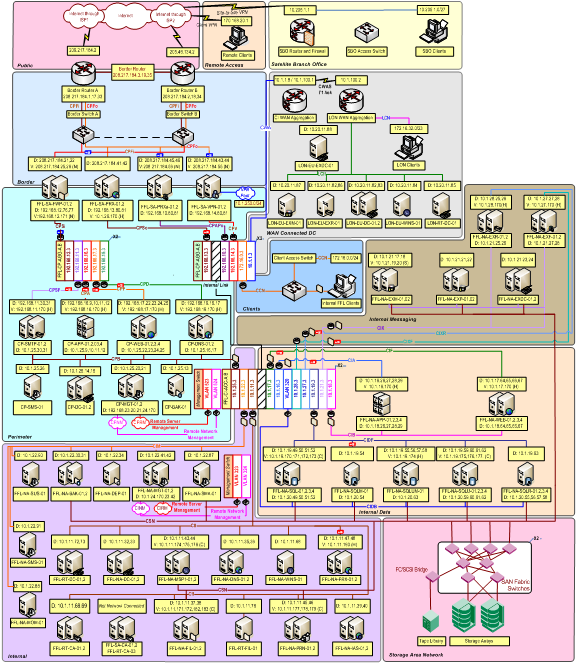
The environment needs Microsoft Windows systems. When building a Windows environment start with a Domain Controller and a Member server (TechNet, 2009). A more complex configuration is described in the Windows Server System Reference Architecture (WSSRA) documentation (Microsoft, 2005). It uses a modular approach that allows users to focus on the scenarios or services that are more relevant for their needs. With overview documents, reference blueprints, architecture blueprints, service blueprints and exhaustive implementation guides that will help the users design and implement IT services based on the use of Windows Server Systems products within the context of a real-world enterprise scenario using a fictitious organization, named Contoso (Microsoft, 2005). This documentation was written in 2005 and considers Windows Server 2003 to build foundational infrastructure services. Even though, the WSSRA is a complex set of guidance spanning more than 3,500 pages and contains more information than what is needed, it is a great guide and helps to build a Windows environment. Over time, the services covered by WSSRA are being updated and replaced with the Infrastructure Planning and Design (IPD) Series which will cover Windows Server 2008 (Microsoft, 2012). Below is the logical diagram that illustrates the infrastructure that is build throughout those guides.

hotsecurity-fig4a

In the small environment that we are building in order to perform hands-on security, two Windows machines were used. After having the first Windows machine deployed with a baseline configuration and device drivers installed from VMware Tools, the reader should sysprep it. Next, shutdown the system, compress it, and save it to a separate folder. This folder will be the repository of ready to deploy gold images. Please consider that the sysprep method is to avoid SID duplications when cloning windows machines. Mark Russinovich explains it perfectly: “The Microsoft-supported way to create a Windows installation that’s ready for deployment to a group of computers is to install Windows on a reference computer and prepare the system for cloning by running the Sysprep tool. This is called generalizing the image, because when you boot an image created using this process, Sysprep specializes the installation by generating a new machine SID, triggering plug-and-play hardware detection, resetting the product activation clock, and setting other configuration data like the new computer name” (Russinovich, 2009). In addition, after finishing the operating system and driver installation, create a snapshot to save the state of the virtual machine which will allow you to return to any point previously saved. This allows the reset of the virtual machines to a known-good previous state without the need to rebuild the systems from scratch.

The scenario that is described trough these article series uses two Windows 2008 Standard edition servers. One will have the role of Domain controller and Primary DNS server. The other will run a web server, a database server and a development framework. To get the Windows 2008 operating system media the reader can download an evaluation copy from Microsoft’s download center portal or from MSDN if it has a MSDN subscription.

The high level steps needed to create the first Windows Server 2008 are described below:

  • Install and configure Windows Server 2008.
  • Install VMware Tools.
  • Execute Sysprep.
  • Shutdown and compress to a golden image.
  • Start the new system and activate it (or use a trial).
  • Assign the VM network adapter to a custom specific network e.g. VMnet3
  • Assign a static IP address, DNS and default gateway in the desired range.
  • Ping the default gateway.
  • Run dcpromo to install Active Directory Domain Services.
  • Choose to install DNS Server and Create a new Domain in a new Forest e.g. ville.com.
  • Create a VM snapshot.

Web Stack

The next step is to build the second windows machine. This machine will be the web stack with a web server, database and a development framework. Using Windows, IIS, SQL Server and ASP.NET is one option. Another popular choice is Linux, Apache, MySQL and PHP. The first option was chosen. After some research the book “Build Your Own ASP.NET 4 Web Site Using C# & VB” was used because it gives a step-by-step approach to build a web stack using ASP.NET framework (Posey, Barnett & Darie, 2011).

The first steps are to install the required software i.e., Visual Web Developer 2010 Express Edition, .NET Framework 4 and the .NET Framework Software Development Kit (SDK), Microsoft SQL Server 2008 R2 Express Edition and SQL Server Management Studio Express  (Posey, Barnett & Darie, 2011).

Then with the web stack ready, the reader can start by creating the first Hello ASP.NET page and getting an understanding how it works in the background. While following the book and advancing trough the chapters to build the web application you will start to get familiar with topics like view state, global configuration, server and client side data validation, visual design and code-behind files, debugging and error handling and interacting with a relational database via ADO.NET (Posey, Barnett & Darie, 2011).

Below are the high level steps needed to do install the Windows Server 2008 and Web Stack:

  • Deploy Windows Server 2008 from previous golden image.
  • Start the new system, define the hostname, admin password and activate it (or use a trial).
  • Assign the VM network adapter to a custom specific network e.g. Vmnet3.
  • Assign a static IP address, DNS and default gateway in the desired range.
  • Ping the default gateway.
  • Join the system to the Domain.
  • Create a VM snapshot.

Next the high level steps to create the web stack by following the Build Your Own ASP.NET 4 Web Site Using C# & VB book  (Posey, Barnett & Darie, 2011).

  • Install IIS 7.x with ASP.NET application development support.
  • Install Visual Studio 2010 Web Express Edition.
  • Install .NET 3.5 SP1.
  • Install KB942288.
  • Install SQL Server 2008 Express R2.
  • Build the ASP.NET application.

Artillery – Tools of the Trade

After having the initial infrastructure in place the reader will need to build an arsenal of tools that will get him well equipped to practice, learn and perform offensive techniques. One of the best suites available is the Kali Linux. This distribution brings the instruments needed in order to execute the steps an intruder will eventually perform during an attack. Depending on the reader’s choice, Kali Linux is available in ISO or VMware image format.  Similarly arsenals are available like the Samurai Web Testing Framework created by Kevin Johnson of Secure Ideas and Justin Searle of UtilSec which focus on web application penetration testing (Johnson). Other alternatives exist such as Pentoo, Matrix, NodeZero, or Katana which consists of a multi-boot DVD that gathers a number of different tools and distributions in a single location (Engebretson, 2013). Moreover, the reader can choose a preferred operating system and start collecting and installing the tools needed depending on the task or technique. In our environment ,Backtrack R5, which is a precursor of Kali, will be used (Security).

Even though the BackTrack distribution is well known in the security community, many of the tools have malicious capabilities, can cause damage and take systems offline. Make sure to keep those tools in a controlled environment and behind a firewall to minimize the possibility of misuse. You never know if the tools have a hidden feature that targets the user system. In some cases, after trying the tools and techniques, the target operating system needs to be rebuilt. This is another area where VMware shines. Rather than physically reinstalling the operating system or application, its original configuration can be easily restored using snapshots.

In this case the BackTrack was installed from the ISO image and positioned into the bridge network as illustrated in part one. The default gateway on the system points to the virtual firewall’s IP address. The installation of BackTrack or Kali is easy and simple and allows the reader to have a ready system with all the tools needed.

Part 3 will describing how the ASP.NET web site code was modified in order to make the application less secure. This will allow us to understand the security techniques employed by the application in order to make it defenseless and practice our security tools and techniques!

References:

TechNet, M. (2009, 06). Step 1: Setting up the infrastructure. Retrieved from http://technet.microsoft.com/en-us/library/dd883274(v=ws.10).aspx
Microsoft. (2005, 12 04). Windows server system reference architecture (wssra). Retrieved from http://www.microsoft.com/en-gb/download/confirmation.aspx?id=15777
Microsoft. (2012, 03 1). Infrastructure planning and design guide series. Retrieved from http://technet.microsoft.com/en-gb/solutionaccelerators/ee382254.aspx
Microsoft. (2013, 11 16). Memory limits for windows releases. Retrieved from http://msdn.microsoft.com/en-us/library/windows/desktop/aa366778(v=vs.85).aspx
Russinovich, M. (2009, 11 3). [Web log message]. Retrieved from http://blogs.technet.com/b/markrussinovich/archive/2009/11/03/3291024.aspx
Posey, T., Barnett, W., & Darie, C. (2011). Build your own asp.net 4 web site using c# & VB, 4th edition. SitePoint
Security, O. (n.d.). Kali Linux. . Retrieved , from http://www.offensive-security.com/community-projects/kali-linux/
Engebretson, P. (2013). the basics of hacking and penetration testing, 2nd edition. Syngress.

Tagged , , , , , ,

Security Hands-on-Training – Part 1

The information security industry will continue to grow in size, density and specialization (Tipton, 2010). The demand for qualified security professionals who possess relevant knowledge and required skills is growing and will increase substantially (Miller, 2012) (Suby, 2013).  The information security discipline is complex and requires continuous investment in training (Suby, 2013). Recently, various articles posted in the media illustrate demand for security professionals (Ballenstedt, 2012). The Cyber workforce has also increased by 600 percent over the last few years. As an example, a search for the phrase “IT Security” on jobserve.com for IT & Telecommunications industry returned over 5000 jobs in UK. As far as the biggest Swiss job portal jobs.ch is concerned, running the same query resulted in over 300 job postings.

That being said, the following question is being raised: How can one help and facilitate the growth of these information security skills? One key method is via training and education. Even though there are plenty of systematic, formalized security training programs, the hands-on training method provides opportunities to practice skills under the most realistic conditions possible (Sisson, 2001). One option is to  build an environment that is designed to mimic real life situations by creating a simple virtual IT infrastructure lab that will allow simulating complex implementations . This creates an environment that will have the flexibility to accommodate changes by adding and removing components at will. This environment will represent real-world security issues with their respective flaws in an interactive, hands-on experience which comes with greater advantage over traditional learning methods because security issues often require substantial hands-on training in order to be understood and mastered (Erickson, 2008). In addition there is the advantage of being in a controlled environment in which unforeseen events are nonexistent or at least minimized (Gregg, 2008). By creating this environment we foster the knowledge and promote learning. Topics such as incident handling, intrusion analysis, system administration, network security, forensics or penetration testing can be practiced, explored and explained.

In order to maintain focused, we need to define a clear scope while creating such an environment. Each one of the aforementioned security domains would take several book volumes to be adequately covered. The environment is flexible enough to allow simulating any of those domains. In this article series we will focus only on familiarizing users with offensive and hacker techniques, attack methods and exploits – all of which the reader can learn, practice at his or her own pace. We won’t focus on the countermeasures or defensive techniques which can be an opportunity for the reader to conduct further research. For example, an incident handling question could be: how could you better prepare and be able to identify such attack methods? Or how could you contain, eradicate and recover from such attacks? This article series aims to provide an introduction and encourage further research using the same or similar environments.

It is important to realize that some of the techniques that will be demonstrated could be used to commit nefarious acts, and this series of articles only provides them so the reader understands how attack methods work. It is also important to understand that as a security professional, readers should only use these methods in an ethical, professional and legal manner (Skoudis & Liston, 2005) (John & Ken, 2004).

The methodology presented creates an environment that will mimic a small business network which will be modified in order to make its defenses weaker or stronger depending on the offensive tools and techniques the reader wants to practice.  In addition, a combined arms approach is used to raise awareness of how combining different tools and techniques can lead to more powerful attacks. Throughout the series of articles the reader is encouraged to practice other scenarios and further explore the techniques and move into more advanced topics.

Get the Environment Ready

Whether the reader is running Linux, Windows or OS X, a virtual environment can be easily build. There are a variety of virtualization systems and hypervisors available. The VMware Workstation was chosen due to personal preference, wide range of operating systems supported, and affordable price. Other open source and commercial solutions are available and the “thehomeserverblog.com” maintained by Don Fountain contains great articles about them.

Use at least two monitors. The system should be equipped with sufficient RAM and fast I/O like SSD drives or USB 3.0 ports. In most cases an average desktop or laptop can run 2 to 3 machines but a more powerful system with 32GB RAM and enough storage can easily perform with 18 VMs. The first system to be deployed should be a 64 bit host operating system e.g., Windows 7 Professional in order to accommodate enough RAM (Microsoft, 2013). Next the hypervisor software is installed. In this case will be VMware workstation 8. The second component that should be built is a virtual firewall that will be the gateway to the isolated and controlled environment. This is important because the reader does not want to practice tools, exploits and other nefarious software in its home or production network (John & Ken, 2004).

The firewall should have several interfaces mapping to different VMnets which will result in having different networking segments protected by firewall rules and routing. The reader can start with a single-arm DMZ. For a more realistic setup, a DMZ screened subnet approach with a dedicated segment for a management network is preferred. Moving beyond this by adding additional tiers of security is always possible at cost of proportional increase of environment complexity and resources. One of the interfaces of the firewall should be the management interface where the management traffic will reside and where the management systems are.  Another interface of the firewall is considered the external. This interface, in the VMware terminology, is configured as Bridge mode. It will connect the environment to the real-world (host network) where the reader might have his wife’s and kid’s laptop plus the wireless and router devices to be able to connect to the Internet.

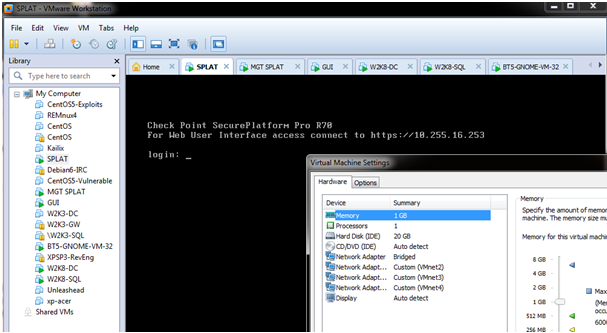
The environment used here contains a distributed Checkpoint firewall but any other firewall would work. The reader should choose one that he feels comfortable with or one that he would like to learn about.  The distributed Checkpoint installation is made up of two machines: a firewall module and a management station based on SPLAT version R70. Both machines are managed using a Windows server called GUI, that contains the Smart Console client software.

hotsecurity-fig1

To optimize the install, the DHCP server will be disabled and each VMnet will be mapped to an appropriate network range.

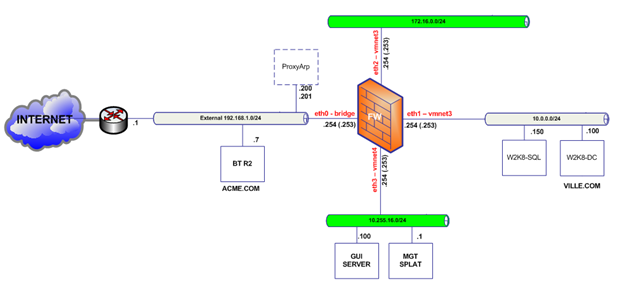
In this environment three (3) DMZ networks were created in the firewall. Each DMZ is assigned an RFC1918 IP network range and will be mapped to a different VMware network. Below figure depicts the network diagram and the high level steps to create the environment are described on the end of this article.

hotsecurity-fig2

In terms of firewall rules the environment contains a very simple approach where HTTP traffic is allowed from anywhere to the Web server. This is a typical scenario in a small business network. Then the internal DNS server is allowed to make UDP connections towards a public DNS server. Another rule allows NTP synchronization between the various machines and a public NTP server. Management traffic that allows communicating with the firewall is defined by default as part of the implicit rules. The initial firewall rule base is shown in the figure below.

hotsecurity-fig3

Below are the high level steps that describe how to create the environment:

  1. Install the host operating system e.g. Windows 7 PRO 64bits.
  2. Install VMware Workstation 8.
  3. Configure VMnets using Virtual Network Editor.
  4. Install and configure the Checkpoint Management Station R70 in VMnet4.
  5. Install Windows OS and Checkpoint Smart Tools in VMnet4.
  6. Install Checkpoint Firewall R70.
  7. Configure the Firewall with 4 interfaces.
  8. Configure routing and define the firewall rules.
  9. Test the connectivity among the different subnets.

Part 2 will follow with windows systems and infrastructure.


References:

Suby, M. (2013). The 2013 (isc)2 global information security workforce study. Retrieved from https://www.isc2cares.org/uploadedFiles/wwwisc2caresorg/Content/2013-ISC2-Global-Information-Security-Workforce-Study.pdf
Skoudis, E., & Liston, T. (2005). Counter hack reloaded: A step-by-step guide to computer attacks and effective defenses, second edition. Prentice Hall..
Gregg, M. (2008). Build your own security lab: A field guide for network testing. John Wiley & Sons.
John, A., & Ken, B. (2004). Creating a secure computer virus laboratory. Manuscript submitted for publication EICAR 2004 Conference, Department of Computer Science, University of Calgary.
Erickson, J. (2008). Hacking: The art of exploitation, 2nd edition. No Starch Press.
Tipton, W. Hord, “Preface” Preface (2010). Official (isc)2 guide to the issap cbk. Auerbach Publications.
Miller, J. (2012, 10 31). Napolitano wants nsa-like hiring authority for dhs cyber workforce. Retrieved from http://www.federalnewsradio.com/473/3101703/Napolitano-wants-NSA-like-hiring-authority-for-DHS-cyber-workforce
Ballenstedt, B. (2012, 08 12). Dhs seeks cyber fellows. Retrieved from http://www.nextgov.com/cio-briefing/wired-workplace/2012/11/dhs-seeks-cyber-fellows/59197/?oref=ng-voicestop

Tagged , , , , , ,

Your data has been taken hostage!

ransomwareOn December 1989, several thousand diskettes labeled “AIDS Information – Introductory Diskette Version 2.0” were delivered to users around Europe luring the users to install a software that contained information about AIDS/HIV claimed to come from PC Cyborg Corporation. After installing the software the trojan horse would start encrypting sections of the hard drive using substitution ciphers.  Following a reboot a message would be shown to the user that the software license had expired and the user would need to send 189$ to a post box in Panama to get his files back.  This was the first extortion based attack relying on cryptography. Not long after a decryption routine was made available to help users get their files back. This was possible because the trojan horse relied on weak symmetric encryption [1].

Malicious cryptography evolved and back in 1996, Adam Young and Moti Yung published a paper on the 17th IEEE Symposium named Cryptovirology: Extorsion based security threats and countermeasures. A influential paper that presented the idea of cryptovirology and demonstrated the offensive side of cryptography using asymmetric encryption. One of the offensive method described in the paper consists of an extortion based attack that will result in loss of access to information.   This is accomplished by the cryptovirus:  A cryptovirus (cryptotrojan) is a computer virus (Trojan horse) that uses a public key generated by the author to encrypt data that resides on the host system, in such a way that can only be recovered by the author of the virus (assuming no fresh backup exists).  Years after, the security industry started to see more of this type of extortion based attacks such as the GpCode trojan initially seen in 2004 by security software company Kaspersky. Some variants claimed to be using strong asymmetric algorithms such as RSA but they used weak algorithms allowing researchers to retrieve the users files.  Michael Ligh had a nice write up on one of these variants here and more recently the security researcher XyliBox also dissected one of these samples.

Last year and this year the security industry saw a uptick in malware connoted as ransomware such as variants of Cryptolocker, CryptoDefense and Cryptowall. Dell SecureWorks Counter Threat Unit have great write up here and here about these threats. These extortion based attacks gained popularity due to its spread using effective phishing campaigns – check Brian Krebs on Operation Torvar – and new techniques relying on strong encryption to make your most important files useless. New variants of ransomware even take advantage of asymmetric cryptographic protocol ECDH – Elliptic curve Diffie–Hellman.  Essentially the files are encrypted with a symmetric key and this key is then encrypted with a public key which can only be decrypted by a private key belonging to the attacker. To get this key the users are persuaded to pay a bounty using virtual currencies such as Bitcoin. The security company Bromium recently published an interesting analysis report about the crypto malware families seen in the past 18 months.

What can you do? The most effective defense against these type of threats is to have proper backups. This type of malware has the capability to encrypt any attached storage such as USB drives or network drives – make sure you do your backups and keep that external drive disconnected. You back up your data once a day, right? at least weekly? maybe monthly? For enterprises the tools and processes used to backup and restore information in a timely manner need to be in place. Please note that Windows has a feature called Volume Shadow Copy that allows you to restore files to their previous state however the newer variants of this malware delete shadow copies and disable the service prior to encrypting the files.

Other things can be done, like educating users to not open attachments or links in emails from unknown senders and be suspicious about unexpected attachments and links from known senders. Also make sure to keep your software updated. Other techniques might include hardening your system using Microsoft AppLocker to introduce software whiltelisting.

[1] Szor, Peter (2004) The Art of Computer Virus Research and Defense. Addison-Wesley

Tagged , , , , , , , ,

2014 – Campaign’s of Cyber Espionage

apt-reports-1[In the article below, a summary of publicly disclosed cyber espionage campaigns released during 2014.  An interesting read for those in the information security field.~Luis]

In January 2014 security software vendor Symantec published a report about a campaign of attacks that targeted the energy sector. The report Targeted Attacks Against the Energy Sector. According to Candid Wueest : The energy sector has become a major focus for targeted attacks and is now among the top five most targeted sectors worldwide. Companies in the sector are facing a growing risk of having their services interrupted or losing data.

In February 2014, Russian security software vendor Kaspersky released a report describing a series of attacks observed against 31 countries. The code named they used to refer to the incidents was Careto.  Unveiling “Careto” – The Masked APT. The Mask is an advanced threat actor that has been involved in cyber-espionage operations since at least 2007. The name “Mask” comes from the Spanish slang word “Careto” (“Ugly Face” or “Mask”) which the authors included in some of the malware modules.

During the same month the security company Trend Micro released its findings about the Russian underground. This report Russian Underground Revisited is the second part of a report that was initially released in 2012 which provided a summary on the underground market. Places in the Internet where cybercriminals converge to sell and buy different products and services exist. Instead of creating their own attack tools from scratch, they can instead purchase what they need from peers who offer competitive prices.

A few months later, Symantec described a series of attacks mainly against energy sector companies.  Dragonfly: Cyberespionage Attacks Against Energy Suppliers A cyber espionage campaign against a range of targets, mainly in the energy sector, gave attackers the ability to mount sabotage operations against their victims. The attackers, known to Symantec as Dragonfly, managed to compromise a number of strategically important organizations for spying purposes and, if they had used the sabotage capabilities open to them, could have caused damage or disruption to the energy supply in the affected countries.

June was  the month when the security company Crowdstrike released its findings about campaign code named Putter Panda.  CrowdStrike has been tracking the activity of a cyber espionage group operating out of Shanghai, China, with connections to the People’s Liberation Army Third General Staff Department (GSD) 12th Bureau Military Unit Cover Designator (MUCD) 61486, since 2012.

In July, another report from Kaspersky came forward. This time with the code name Energetic Bear more like a Crouching Yeti . Kasperspky also release an appendix containing IOCs.  Energetic Bear/Crouching Yeti is an actor involved in several advanced persistent threat (APT) campaigns that has been active going back to at least the end of 2010.

A report issued by CrowdStrike described sophisticated attack against a large Fortune 500 company, Campaign code name Deep Panda. In late December 2011, CrodwStrike received three binary executables files that were suspected of having been involved in a sophisticated attack against a large Fortune 500 company. The files were analyzed to understand first if they were in fact malicious, and the level of sophistication of the samples.

Noteworthy, a report released by the company AIRBUS Defence & Space with the code name Operation Pitty Tiger – “The Eye of the Tiger”. This report contained information on a group of APT attackers known as “Pitty Tiger”. This information comes directly from investigations led by our Threat Intelligence. Pitty Tiger is a group of attackers that have been active since at least 2011. They have targeted private companies in several sectors, such as defense and telecommunications, but also at least one government.

Key findings about a campaign code named  The Epic Turla Operation was released in August by Kaspersky. This was the result of 10 months of investigation on attacks against more than 45 countries. The company also released an appendix with  IOCs. Kaspersky Lab researchers have analyzed a massive cyber-espionage operation which we call “Epic Turla”. The attackers behind Epic Turla have infected several hundred computers in more than 45 countries, including government institutions, embassies, military, education, research and pharmaceutical companies. The attacks are known to have used at least two zero-day exploits.

Operation Arachnophobia was the code name for a campaign released by the company ThreatConnect working in collaboration with Fireeye. We first discovered a suspected Pakistani threat group in 2013, and have since followed their activity and found new observations and insight into the group and its tactics that we call, “Operation Arachnophobia”.Working in collaboration with FireEye Labs, the TCIRT team has discovered evidence pointing to this groups continued exploitation operations using custom malware, dubbed BITTERBUG by FireEye.

In October iSIGHT Partners released the details of a campaign code named Sandworm . A report that disclosed the usage of a 0 day vulnerability used against Western governments, NATO and the Ukrainian government. in close collaboration with Microsoft – announced the discovery of a zero-day vulnerability impacting all supported versions of Microsoft Windows and Windows Server 2008 and 2012. Microsoft is making a patch for this vulnerability available as part of patch updates on the 14th  – CVE-2014-4114.Exploitation of this vulnerability was discovered in the wild in connection with a cyber-espionage campaign that iSIGHT Partners attributes to Russia.

During the same month the security software company Sophos released a report code named  The Rotten Tomato Campaign . Gabor Szappanos, of SophosLabs Hungary, writes an interesting dive into the world of the attackers, examining the malware used by cybercriminals in these attacks, and shows how several different groups used the same zero-day Microsoft Word exploit.

A series of attacks targeting companies in the Defense Industry was code named Operation Death Click and released by Invincea. Most targeted attacks against organizations originate as spear-phish campaigns or watering hole style web driveby attacks. Within the last six months, Invincea has discovered and stopped targeted malvertizing attacks against specific companies — particularly those in the Defense Industrial Base.

A large scale effort that targeted Fortune 500 companies code named  Operation SMN : Axiom Threat Actor Group Report was disclosed by the software analytics company Novetta. The company also released extra resources varying from static analysis of the malware to yara signatures. Axiom is responsible for directing highly sophisticated cyber espionage operations against numerous Fortune 500 companies, journalists, environmental groups, pro-democracy groups, software companies, academic institutions, and government agencies worldwide for at least the last six years.

The Italian firm Tiger Security disclosed details about Operation Distributed Dragons Although it is no news that the way of performing attacks continuously changes shape and form, since January 2014 there has been evidence of a new “breed” of Chinese DDoS attacks based on the breach of Linux servers, whose objectives are not completely clear but significantly different from the approach so far experienced.

A series of incidents targeting United States and its allies using spear-phishing tactics was released by TrendMicro  – Operation Pawn Storm – Using Decoys to Evade Detection. Operation Pawn Storm refers to economic and political espionage attacks instigated by a group of threat actors primarily targeting military, embassy, and defense contractor personnel from the United States and its allies.

The German security software company G Data Software published the details about OPERATION “TOOHASHThe experts of G DATA’s SecurityLabs discovered a cyber-espionage campaign that perfectly exemplifies the way how targeted attacks work. The purpose of this campaign was to steal valuable documents from the targeted entity. We entitle this operation “TooHash”.

Still in October the security software vendor Fireeye published a report about a campaign of attacks that targeted the energy sector. APT28: A WINDOW INTO RUSSIA’S CYBER ESPIONAGE OPERATIONS? In this paper we discuss a threat group whose malware is already fairly well-known in the cybersecurity community. This group, unlike the China-based threat actors we track, does not appear to conduct widespread intellectual property theft for economic gain. Nor have we observed the group steal and profit from financial account information.

Last week the details about a campaign code named The Dark Hotel APT were released by Kaspersky . Facts about attackers that have been active for at least seven years, conducting targeted strikes against targeted guests at other luxury hotels in Asia as well as infecting victims via spear-phishing attacks and other mechanisms. The company also released an appendix with IOCsThe Darkhotel APT is a threat actor possessing a seemingly inconsistent and contradictory set of characteristics, some advanced and some fairly rudimentary.

Tagged , ,