Author Archives: Luis Rocha

Digital Forensics – Evidence Acquisition and EWF Mounting

[This is my first post on a series of articles that I would like to cover different tools and techniques to perform file system forensics of a Windows system. First article is about acquiring a disk image in Expert Witness Format and then mounting it using the SIFT workstation. LR]

Let’s look at an hands-on scenario to create a forensic image from a compromised system. To acquire the disk we will boot the system from a CD/USB using Helix and then run ewfacquire. Ewfacquire is a tool that allows us to acquire media and stored it in Expert Witness Format. Essentially, it can acquire media in an equivalent format that commercial tools like EnCase and FTK imager do. EWF format is very popular due to the market penetration of Guidance Software and their Encase Suite. The EWF format also know as Encase evidence files (E01) are a representation of the acquired physical or logical drive. Plus they support metadata, the evidence hash value, compression and file splitting. These features are very convenient.

Ewfacquire is simple and flexible tool that is part of the LibEWF package that contains many other great forensic tools written by Joachim Metz. It is launched using the command line and is preinstalled in Linux distributions like Helix and SIFT Workstation. In this case we will run use Helix. Helix product went commercial but you can still download the free 2009R3 version.

Frist step is boot the compromised system with a CD/USB using Helix. Then we will plug the pristine media where we will store the evidence and mount it. Following that we launch ewfaquire.  On a previous post I wrote about the first two steps.

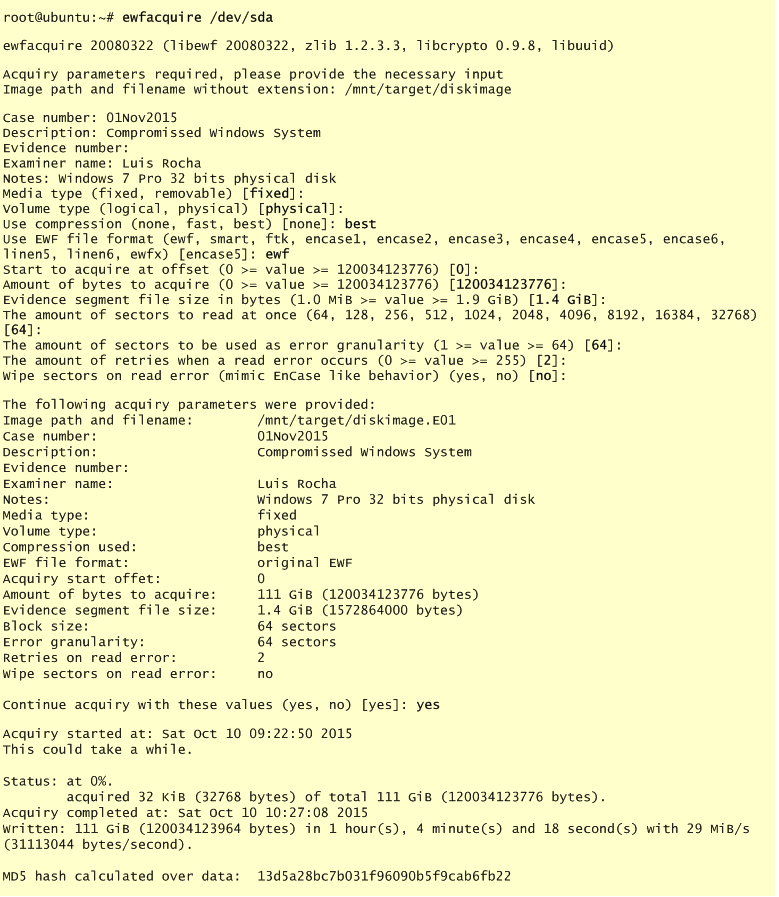
In this exercise we will concentrate on ewfaquire. We can see the source and destination devices by running fdisk -lu. Then we know which drive will be the source and the destination. In this case the source drive is /dev/sda. We then start the acquiring process by launching the ewfacquire tool  with source drive as option and a set of questions will be raised. Below picture ilustrate this steps. The values are self explanatory. In this case we are aquiring a physical disk using the best compression method in EWF format.  After entering the default values which are good enough for the majority of the case were are asked to review the settings and then proceed. The process will take some time depending on factors like disk size and compression method. When finish the evidence hash value is presented. All this information is stored in the metadata and can be reviewed afterwards with ewfinfo.

ewfacquisition

After the acquire process is finish we will have a bunch of .E## files in our target media. Next step is to move them to our SIFT workstation and process the image.

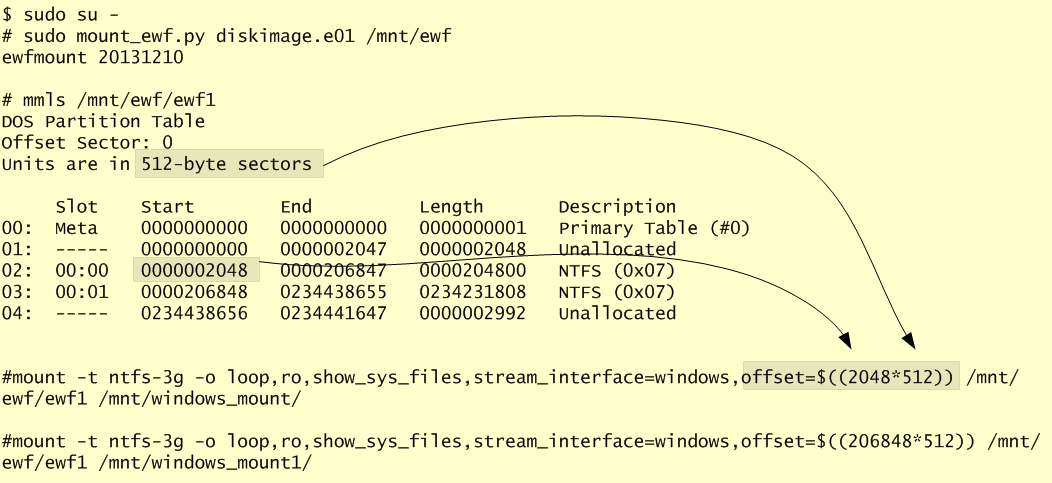
This will take three steps. First we mount the EWF files using mount_ewf.py, then we get the partition layout using mmls and finally we run the mount command. Mount_ewf.py is a script written in Python by David Loveall and available in SIFT workstation that allows us to read the evidence in EWF format and prepare it in a way that can be mounted. Then we use mmls from thesleuthkit written by Brian Carrier to display the partition layout of the physical disk we acquire. With mmls we find the starting sector for each one of the NTFS partitions and we use that value in the mount command. Finally, we use the mount command for each partition we want to mount.

In the mount command we have different flags. The loop suffix allows us to mount disk images. The ro is to ensure we mount the evidence in read only. The show_sys_files is important if we want to see the NTFS metadata. Then the stream_interface=windows is used in order to be able to read data streams such ADS. Finally, the offset is calculated by multiplying the starting sector with the amount of units we have per sector (a.ka. bytes per cluster). The following image illustrate these steps.

ewfmount

After mounting the different partitions into /mnt/windows folder we can see their contents. Because we mount it with the show_sys_files option. we can see the different NTFS metadata files that start with $.

ewfmount1

That’s it! The techniques and tools are not new. However, the tools are open source and the techniques are relevant and used in today’s digital forensic analysis. Next step, produce a forensic timeline!

Tagged , , , , ,

CryptoWall Strikes Back!

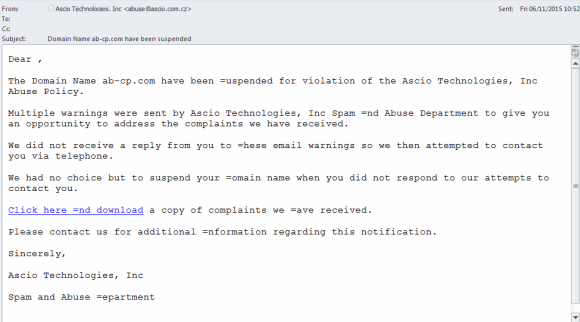
A new variant of Cryptowall ransomware has been observed in recent phishing campaigns by the security community. The image below illustrates one of these emails where the sender falsely states that your domain name is going to be suspended due to abuse policy. This email attempt to lure the recipient into clicking into the link.

cryptowall3

The link points to a compromised web server using a scheme like http://www.site.com/abuse.php?domain.com

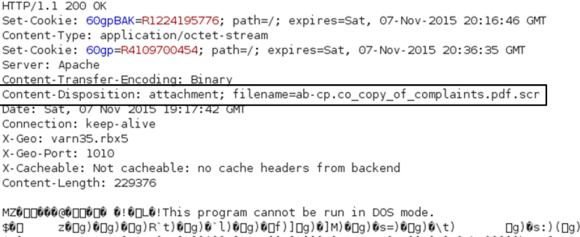
When clicking on the link the HTTP answer uses a Content-Disposition field. Using this technique the answer to the PHP request will be a file. Download of content like executables is does not need this field  but in this way the malware authors attempt to camouflage the file in the GET request.

cryptowall

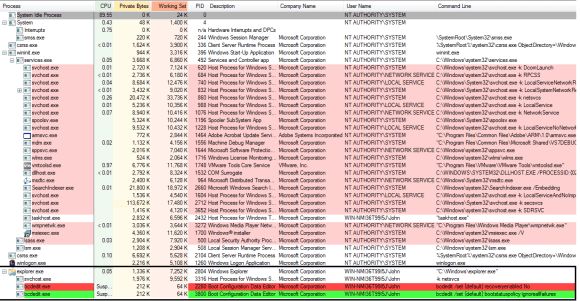
When executed, CryptoWall uses several memory management techniques to inject into benign processes. It starts by making a copy of itself and then invoking a new explorer.exe process which by its turn will invoke a new svchost.exe. These two new processes (see below figure) are valid process initiated using the legitimate system binary but have been injected with malicious code using hollowing technique. Svchost.exe in this case is invoked “-k netsvcs” but the process parent is  not services.exe which should always be the case.

cryptowallprocess

Before the encryption starts,  it will execute three commands that will make recovery of files even more difficult. It starts by deleting all Volume Shadow Copies that exists on the system by running the following command:

  • vssadmin.exe Delete Shadows /All /Quiet

Then runs the following commands in order to disable the Windows Error Recovery during startup:

  • bcdedit /set {default} recoveryenabled No
  • bcdedit /set {default} bootstatuspolicy ignoreallfailures

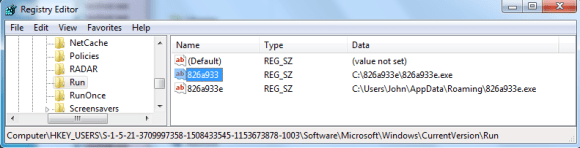
To achieve persistence, a copy of the malware is placed into a directory named with a random hexadecimal  number under c:\. The Hidden attribute is set to the folder. Inside will store the malicious executable using a an equal filename e.g., c:\826a933e\826a933e.exe. It addition another copy of the malware is placed into the directory %APPDATA%\Roaming. Then it creates a Run key under HKLM or HKCU registry hive (depending on the admin rights) that points to this executable. This will make sure the executable is launched either during boot or during user login.

cryptowallreg

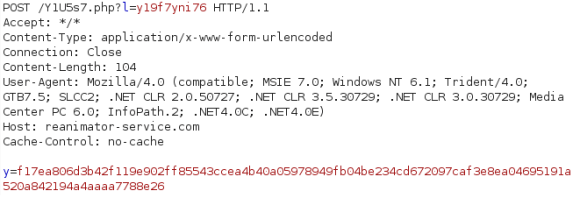
CryptoWall then starts its communications and will determine the victim public IP address and its geo-location using sites like curlmyip.com, myexternalip.com and ip-addr.es. Following that will try to reach out one of the many C&C addresses that are hard-coded into the binary.

The following picture illustrates the messages that are sent over HTTP on TCP port 80.

cryptowallcomms

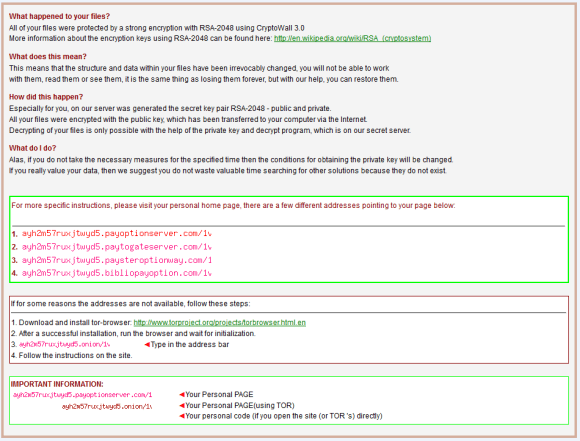
After the encryption process is finished the user is presented with the ransom messages. For each folder that CryptoWall processes it will leave its ransom note on the following files HELP_YOUR_FILES.HTML, HELP_YOUR_FILES.PNG, HELP_YOUR_FILES.TXT. One example is below.

cryptowall1

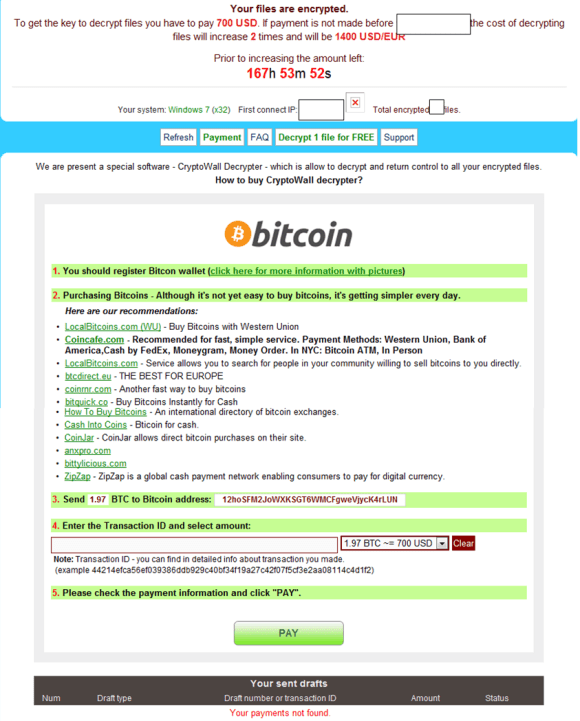
If the user follows the ransom note instructions he will be redirected to the decryption service and is prompted to pay in Bitcoins. The decryption service will allow to decrypt one file for free.

cryptowall4

What can you do? The most effective defense against these type of threats is to have proper backups. This type of malware has the capability to encrypt any attached storage such as USB drives or network drives – make sure you do your backups and keep that external drive disconnected. You back up your data once a day, right? at least weekly? maybe monthly? For enterprises the tools and processes used to backup and restore information in a timely manner need to be in place. Please note that Windows has a feature called Volume Shadow Copy that allows you to restore files to their previous state however the newer variants of this malware delete shadow copies and disable the service prior to encrypting the files.

Other things can be done, like educating users to not open attachments or links in emails from unknown senders and be suspicious about unexpected attachments and links from known senders. Also make sure to keep your software updated. Other techniques might include hardening your system using Microsoft AppLocker to introduce software whiltelisting.

MD5 of the malware used in this article:
3548959f1100a0d818f91b6502a7fdd3 ab-cp.com_copy_of_complaints.pdf.scr

At this stage the majority of the web filtering vendors have categorized the C&C addresses as malicious. This will prevent an infected computer  from becoming encrypted if you prevent your users to surf to malicious websites. For example the malicious binary used in this exercise had 58 C&C hard-coded.

Tagged

Course Review: SANS FOR578 Cyber Threat Intelligence

KillChain

Image retrieved from lockheedmartin.com

Last week I had the opportunity to attend SANS DFIR Prague where I completed the SANS FOR578 course “Cyber Threat Intelligence” (CTI) with Robert M. Lee.  Robert is one of the co-authors of the course and is brilliant instructor that really knows his stuff.  Everything stands or falls with the quality of the instructor and I believe Robert did give us (students) a great learning experience with great interactions and discussions. Among other things Robert is the CEO of the security company Dragos Security and has worked in the US Air Force which allows him to talk genuinely about the “intelligence” topic.

Overall this was a five day course that immerses the student into the new and emerging field of CTI. During the five days we lived, ate and breathed being a CTI analyst. Being a CTI professional is not an easy task and it’s not in five days that you can expect to become one.  However, in my opinion, if someone has the desire, as well as the ability, this course can give you the means. I’m sure this course gave me important skills and competencies about this new, emerging field. One key take away from the training is that it gives you the foundations to create a threat Intel capability into your organization and enables security personnel to develop more proactive and mature response practices against threats and move defenses higher up the kill chain.

The first day is a comprehensive introduction to the new Cyber Threat Intelligence (CTI) domain, with a wide range of topics and terminology being covered. What is threat intelligence? Why should organizations adopt it? What is the value? What is the difference between a consumer and a producer of CTI? What are the different types of CTI?  In addition, background on the intelligence doctrine and its life cycle is also discussed. The afternoon was spent on the different frameworks and models that you can use to create consistent and repeatable CTI outputs. The Kill Chain, Diamond Model, Courses of Action Matrix and the Detection Maturity Model were the ones most covered.

Day two was all about enforcing the models presented in day one with special focus on the Kill Chain model. Lots of exercises supported by a network intrusion scenario where we (students) needed to perform different tasks to put in practice the theory from day one. The way the intrusion attributes, properties and artifacts are mapped to the Kill Chain, Diamond Model and Courses of Action were really useful. Because the frameworks discussed are complementary they can be combined in order to produce multi-dimensional analysis of the intrusion. I think this multi-dimensional approach to intrusions gives great insight about the adversary. Although a time consuming exercise it was great to get a feeling about what a CTI analyst might do in a organization with high security risk that need to have mature and dedicated teams to perform this type of work.

By leveraging the intelligence gained overtime during the analysis of multiple intrusions we start to get an understanding about commonalities and overlapping indicators. Mapping these commonalities and indicators to the intrusion kill chain and diamond model results in a structural way to analyze multiple intrusions. By repeating this process we could characterize intruders activity by determine the tactics, techniques and procedures on how the attackers operate i.e., perform a campaign analysis. This was day three. A meticulous work that is built over time and needs great amount of support from your organization but after execution it will produce great insight about the adversary. In terms of tools, the exercises relied heavily on Excel and the fantastic and open source Maltego.

Day four was focused on the different collection, sharing and ingestion methods of threat intelligence. The primary method of collection discussed was trough threat feeds.  Other collection methods such as OSINT and threat Intel produced inside the organization or received trough circles of trust were also discussed. For sharing, a key take away is that partners with strong non disclosure agreements are very efficient. Still, in the sharing realm delivering context is crucial in order to make it actionable. Furthermore, we discussed the roles of the different ISAC and other organizations.  Regarding the ingestion, the material has very good coverage on the different standards and protocols that have been developed in recent years to collect share and consume technical information in an automated way. The focus was on STIX, TAXII. We also reviewed other methods and standards such as OpenIOC and Yara rules.  In regards to the tools and exercises we had the chance to play with Recorded Future and Threat Connect and and develop OpenIOC and Yara rules. SANS posture overtime has been always vendor neutral but I must say the Recorded Future demo for OSINT is well worth and the tool is really amazing!

The material on day five is more abstract. Special focus on how people – analysts – make conclusions. For example we discussed the difference between observations and interpretations and how to construct assessments. Great amount of material about cognitive biases and how it might influences the work performed by an analyst. During this day we were also exposed to the analysis of competing hypotheses (ACH) methodology by former CIA analyst Richards J Heuer, Jr. The exercises were really interesting because we had to evaluate hypotheses against the evidences we found during the intrusion analysis of the different scenarios.  By the end of the day we immersed into the topic of attribution and discussion about nation state capabilities and the different cases that have been known in the industry.

Of course apart of the training, was great to attend the DFIR Summit, absorb information, play DIFR NetWars and more important meet new people, share experiences and see good old friends!

Tagged , , , , , ,

Malicious Office Document delivering Dyre

Phishing campaigns that distribute commodity malware are common and ongoing problem for end users and corporations. In this article would like give you an illustration about one email that was part of a phishing campaign that distributes a very successful banking trojan malware known as Dyre or Dyreza. This trojan is quite sophisticated. Among other things is capable of stealing all kinds of credentials from the victim’s computer. It can also redirect victim’s traffic to sites controlled by the threat actors using man-in-the-browser functionality. This allows interception and manipulation of traffic that is supposed to be delivered to legitimate sites. Dyre has remote access functionality that allows the threat actor to connect to websites trough the victim computer.

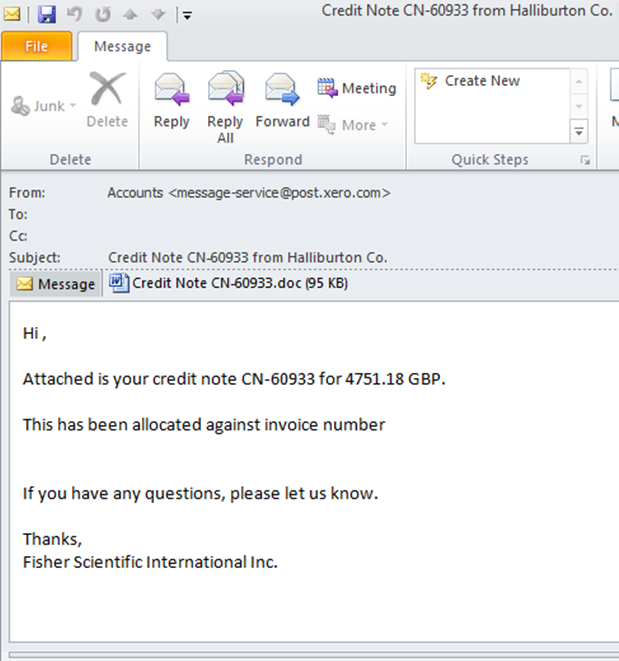
The distribution methods observed is the past are mainly done using phishing emails that include a malicious Microsoft Office document attached. It normally includes a Microsoft Word or Excel document with macros. The image below illustrates one of these samples where the sender falsely mimics a legitimate business transaction. This well-crafted email attempts to lure the recipient into opening the malicious attachment.

email-dyre

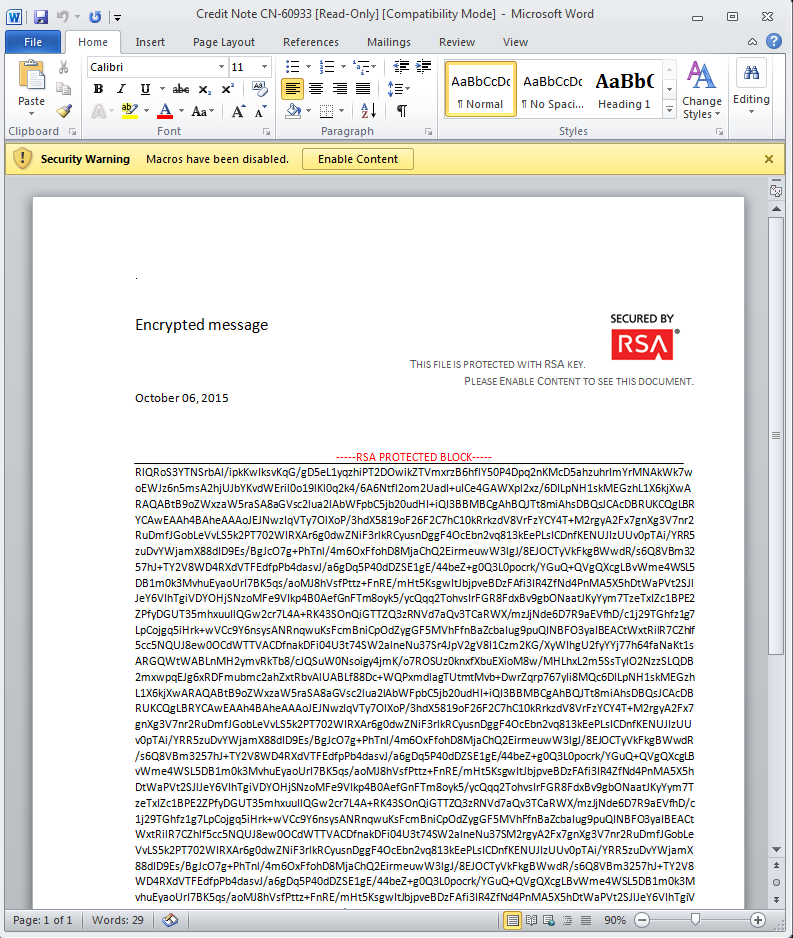
Noteworthy is that the threat actors behind the malware distribution operations go to great lengths ensuring the files are not detected as malicious  by the different security mechanism such as Anti-Spam, Anti-Virus and Sandboxes.  Is quite normal when  submitting this malicious Office documents to Virus Total to have less than 10% detection rate and being rated benign by Sandboxes.In this example as seen in the picture below, the user when opening the email attachment is presented with the information that the document is encrypted with RSA algorithm and the user needs to enable macros in order to see its content.

email-dyre2

The document is of course not encrypted and this is a social engineering technique to trick the users to run the malicious macro. Allowing macros to run causes the malware to be extracted and executed in the victim system.

So what makes this document different than the others recently seen? The difference is in the weaponization mechanism that was used. Traditionally, these malicious Office documents have encoded and obfuscated macros. These macros when executed will connect to a site and download the malicious executable. However, in this case the document contains an obfuscated macro but the executable is embedded within the document.  This reduces the steps needed for infection and might increase the infection rate.

What tools and techniques one could use to unravel what is inside the document?

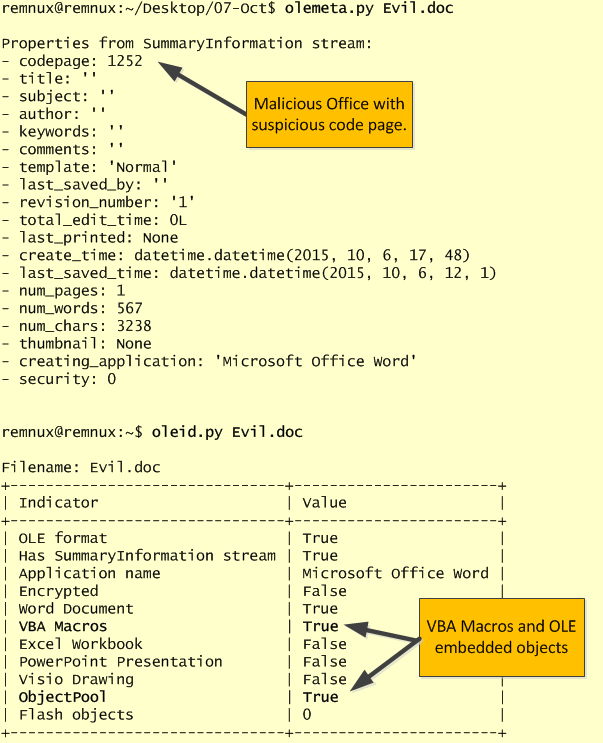
For malicious document analysis, REMnux and the cheat sheet created by Lenny Zeltser are a fantastic companion. On REMnux v6 one of the new tools pre-installed is the python-oletools toolkit. This toolkit was created by Philippe Lagadec based on the work created by John William Davison on officeparser. The tool among other things can parse and extract VBA Macros from Microsoft Office documents. It supports a variety of Microsoft Office documents and it can be very handy for this type of malicious documents. We start with the usage of olemeta.py to view the document metadata. In this case we could see codepage 1252 which might indicate where the document was fabricated. Then we run oleid.py which gives us a very good overview about the capabilities inside the document. In this case we could observe that the document contain VBA macros and OLE embeded objects. These indicators definitely need a deeper look.

email-oletools

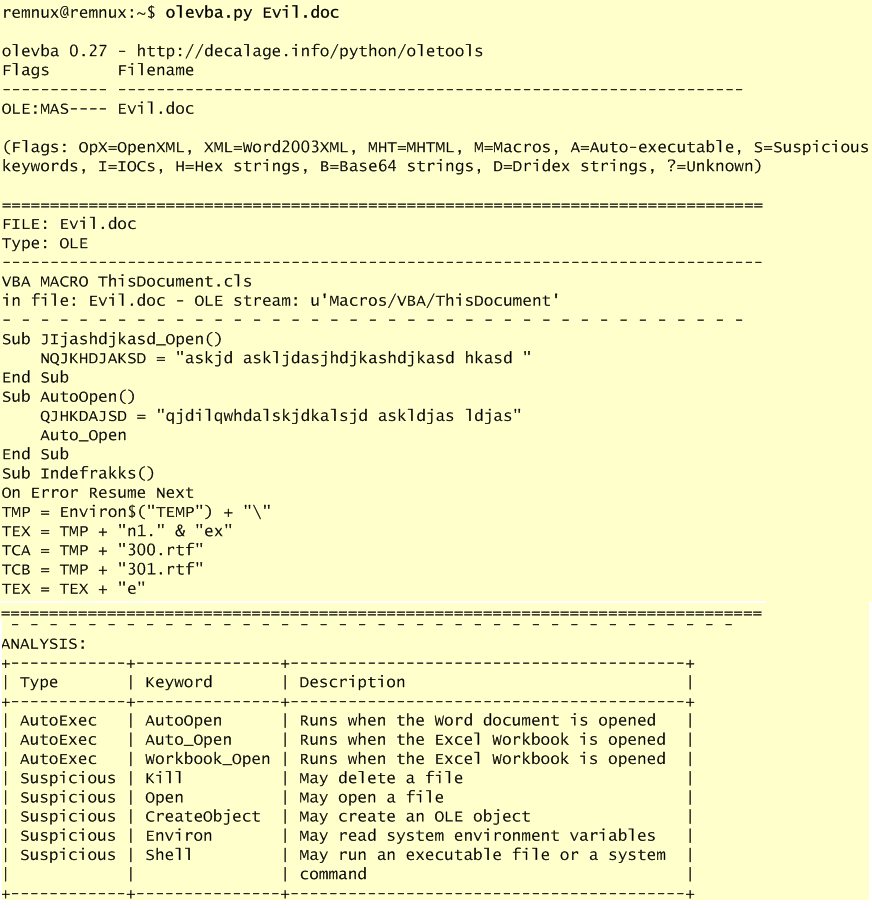
We start by looking at the VBA macro. The following picture illustrates the output given by olevba.py after analyzing the malicious Office document. It shows the actual macro and one could see that is obfuscated. In addition the tool gives its interpretation of the different functions used in the macro. Many of the functions used are considered suspicious.


email-olevba1

Based on this information we can see that the document contains a obfuscated VBA macro that presumably creates RTF files (300.rtf and 301.rtf) and extracts an executable called n1.exe.

To further dig into these artifacts we will use another great tool. Oledump created by Didier Stevens. This tool allows you to analyze OLE files. As stated in the manual page: “Many file formats are in fact OLE files, like Microsoft Office files, MSI files. Even the new Microsoft Office Open XML format uses OLE files for VBA macros”. Another powerful tool created by Didier that even supports decoders and plugins such as Yara rules. One of the Yara rules is based on the work made on OfficeMalscanner  by Frank Boldewin that can find shelcode, PE-files and other embedded streams inside Office documents.

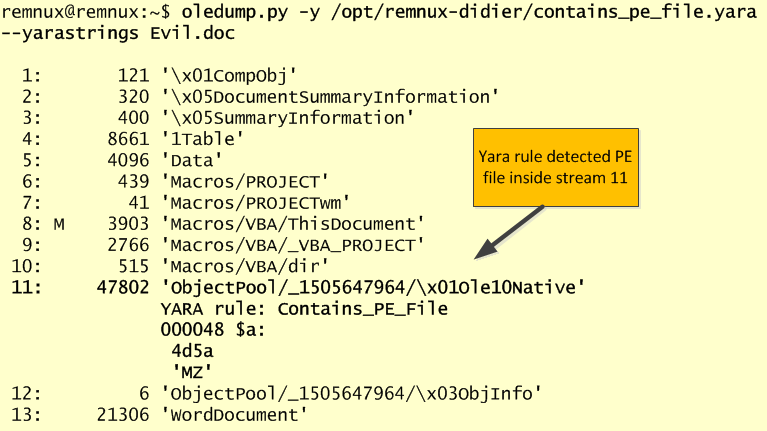
To verify our suspicious we use oledump.py with a yara rule that detects the presence of PE files inside documents. The output confirms that an executable was found inside the document.

email-oledump1

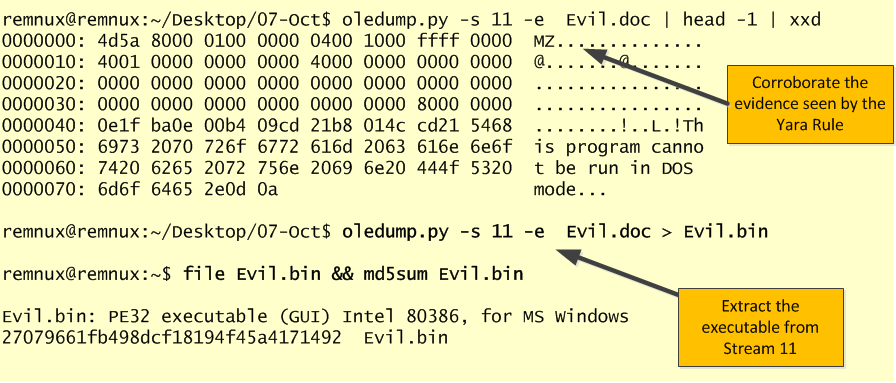
We can now extract the executable. The stream that triggered the Yara rule is the stream 11. Once again using oledump.py we can extract the binary and redirected to a file for further analysis.

email-oledump2

With the executable extracted we can now start  using static and dynamic analysis techniques to determine the malware capabilities and extract IOCs that can be used to across our logs and network to find infected systems. This will be left for another blog post.

E-mail continues to be the weapon of choice for mass delivering malware. The tools and techniques used by attackers  continue to evolve and bypass all the security controls in place. From a defense perspective, the US-CERT put together excellent tips for detecting and preventing this type of malware and to avoid scams and phishing attempts applicable to home users and corporations.


MD5 of the files used in this exercise:
Evil.doc  : dd3cd493aa68f55d1df442873ad2b2e8
Evil.bin : 27079661fb498dcf18194f45a4171492

Tagged , , , ,

Intro to cyber threat intelligence

knowyourenemyThe traditional security monitoring and incident response (IR) capability that has being used across the enterprises in the last decade has fallen behind. It is consensus across the IT security industry that we need a more robust, capable and efficient security monitoring and IR framework. The new framework should enable us to combine security and intelligence functions. An intelligence driven security that allows us to plan for, manage, detect and respond to all categories of threats even as they become more frequent and severe. In other words we want to maximize the organization effectiveness and efficiency to block, detect and respond to attacks. How? By introducing into the traditional security stack the threat intelligence security function we can do more and better.

Following the last post about about what intelligence means and what is the 5 steps of the intelligence cycle below an introduction to  Cyber Threat Intelligence topic.  A quick summary on what is threat intelligence, what is its value and what are the sources to consume or produce intel. More about this topic will follow in future posts.

What is Cyber Threat Intelligence?
Threat intelligence is a recent paradigm in the IT security field that continues to gain a lot of traction due to a change of focus in the risk equation from the vulnerability into the threat. Tracking threats that are specific to your industry, organization or region is key to minimize damage that can caused by an attack.

On the one hand we have strategic threat intelligence. A capability that needs processes, tools and people to leverage an understanding about the attacker’s capabilities and intents. Is normally delivered through reports that are produced by humans and consumed by humans and is the most expensive and hardest to produce. It produces information to support well informed decisions of long-lasting importance such as which policies and processes should change. Or what new changes one should accommodate in the security infrastructure to adapt to the new threat landscape.From a well-established and mature strategic threat intelligence practice you should be able to get answers to questions like: Who is your potential adversary? What is the adversary’s capability to cause you harm? Do they have the intent to cause harm? Where are you vulnerable? How could anyone harm your organization if they wanted to do so?

On the other hand, we have tactical threat intelligence. A capability that aids the prevention, detection and response competencies with real time threat data that is consumed across different systems and functions. Data such as IP addresses, domain names, URLs, email addresses, hashes values, HTTP user agents, registry keys, etc. Remnant pieces of information left by an attacker that can be used to identify threats or malicious actors. These pieces of information are nowadays called indicators of compromise and can, for example, be used to search and identify compromised systems.  This thread data is tactical threat intelligence and is of limited life span. Tactical threat intelligence should be disseminated, integrated and consumed in an automated fashion.  This type of threat intelligence is the cheapest and easiest to create.

What is the value of Cyber Threat Intelligence?
At the strategic level, the value proposition of threat intelligence might include:

  • Make well informed decisions on where you are spending your security dollars.
  • Create comprehensive insight about the threats by developing facts, findings and forecasts about threat actor’s capabilities, motives and tradecraft.
  • Create recommended courses of action on how to adapt to the evolving threat landscape in order to reduce and mitigate risks.
  • Being able to plan for, manage and respond to all categories of threats – even as they become more frequent and more severe.
  • Develop situational awareness about capabilities and intents of your adversaries.
  • Know your adversary and what are they looking for.

At the tactical level, the value proposition of threat intelligence might include:

  • Minimize the risk of attacks that could result in lost revenue, public embarrassment, and regulatory penalties.
  • Improve the effectiveness and efficiency of security monitoring capabilities by integrating and matching threat intel data.
  • Augment security operations and incident response functions with actionable threat data.
  • Reduce the number false positives by adding threat intel data into security operations.
  • Accelerate Incident Response actions and remediation priorities based on targeted information.

What are the sources of Cyber Threat Intelligence?
The sources might vary depending if you are a consumer or a producer of threat intelligence. From a consumer perspective – where the majority of the organizations fit in – they mainly fall into two categories. The open source ones that are free and can be retrieved by anyone. And the closed sources that are commercial or with restricted access. These ones often need a payed subscriptions or being member of a closed circle of trust. Either one, they fall under tactical threat intel when data is delivered to the consumer trough feeds with indicators of compromise. Or they fall under strategic threat intel when the deliverables is a report about capabilities and intents of malicious actors.

From a producer perspective the sources are even broader and using different disciplines. Normally, if you are a service provider there is the incentive to produce it using the most variety of sources, methods and disciplines. Mainly due to the fact service providers do it for a profit. For example, iSight Partners, Dell SecureWorks, Mandiant or CrowdStrike are good examples of service providers that create strategic and tactical threat intelligence combined together. They have dedicated teams of researches that perform all kinds of activities, some of which might be almost considered under intel agencies or law enforcement umbrella. Examples of sources used across producers are honeypots and spam traps that are used to gather intelligence trough the knowledge and information that one could obtain by observing, analyzing and investigating the attacker that are lured to it. Another source could be the output of doing static and dynamic malware analysis.


References:
How to Collect, Refine, Utilize and Create Threat Intelligence by Anton Chuvakin
Security Science by Clifton Smith; David J Brooks
Intelligence-Based Security in Private Industry by Thomas A. Trier

Tagged , ,

The 5 steps of the Intelligence cycle

intelligencecycleBack in 2011, market research companies like IDC, Forrester and Frost & Sullivan were making market analysis about the growth of cyber threat intelligence services and alike. Their analysis stated a double digit growth year of year. Their projections seem reasonable and their current estimations continue in this trajectory.  Nowadays, cyber threat intelligence continues to gain a lot of traction and hype across IT security. However, as many other cases in the IT security, the industry is adopting the jargon used across government agencies and military forces. That being said I wanted to write about cyber threat intelligence. But I thought would be good to first read and understand what intelligence means across the intelligence agencies and military domains in order to have good foundation before applying it to cyber. Below short summary I made on what intelligence is and what the 5 steps of the intelligence are.

What is Intelligence?

Intelligence is the product that results from a set of actions that are performed to information.  Traditionally, used across governmental organizations for the purpose of national security.  The actions are collect, analyze, integrate, interpret and disseminate. The final product of intelligence gives value-added, tailed information that provides an organization or its adversary, the ability to make conclusions. For the enterprise the information product might be to seek information about the threat actors means, motive and capabilities. On the other hand the adversary might want to seek information about intellectual property (patents, copyrights, trademarks, trade secrets, etc) from your company in order to gain economical advantage or to subvert its interests. In any of the cases the information produced gives an edge, a competitive advantage to you or to your adversary.

The information produced contains facts, findings and forecasts that supports yours or the adversary goals.  There are two categories of Intelligence. One is strategic and the other is operational. Strategic intelligence means information produced to support well informed decisions of long-lasting importance. Strategic intelligence is broader and often requires information concerning different fields.  Operational intelligence is of limited life span and it to be used rapidly and is concerned with current events and capability.

What are the 5 steps of the Intelligence cycle?

Planning and direction – This is the first step. It’s here were the requirements and priorities are set. The capabilities to produce Intel are limited as any other resource which means we want to maximize its production with a constant number of resources.  Among others, a methodology to define the requirements might be using the “Five W’s”. It’s also in this step where we define which areas the intelligence produced will have the most impact and make to most contribution.  During the planning is fundamental to specify which categories of Intelligence will be gathered i.e. OSINT (Open Source Intelligence). In addition, the processes, people and technology to support the different steps in the cycle need to be established with clear roles and responsibilities.

Collection – The second step includes all the different activities, mainly research, that involves the collection of data to satisfy the requirements that were defined. The collection can be done either via technical or human means and involves gathering data from a variety of sources.  In the military and intelligence community the sources normally used are people, objects, emanations, records. These sources span the different collection disciplines named as HUMINT, IMINT, MASINT, SIGNT, OSINT and others. Once collected, information is correlated and forwarded for processing and production.

Processing and exploitation – Third step, the collected raw data starts to be interpreted, translated and converted into a form suitable for the consumers of the intelligence. The raw data becomes information.

Analysis and production – The refinement of the information that was produced in the previous step.  The fusion of the different information that was processed from the different intelligence disciplines. These are key tasks performed during this step. The analysis  consists of facts, findings and forecasts that describe the element of study and allow the estimation and anticipation of events and outcomes. The analysis should be objective, timely, and most importantly accurate.  To produce intelligence objectively, the analysts apply four basic types of reasoning. Induction, deduction, abduction and the scientific method. Furthermore, because bias and misperceptions can influence the analysis the analyst should be aware of the different analytical pitfalls. The outcome is value-added actionable information tailored to a specific need. For example,  in the United States, creating finished intelligence for national and military purposes is the role of the CIA.

Dissemination and Integration – Essentially, this step consists in delivering the finished product to the consumers who requested the information. This can be done using a wide range of formats and in a manual or automated manner.

References:
JP 2-0, Joint Intelligence
Operations Security – Intelligence Threat Handbook
USAF Intelligence Targeting Guide
Intelligence Essentials for Everyone


Tagged , , , ,

Hacking Team – Arsenal of Cyber Weapons

hackingteam5Following my last post regarding the Hacking Team breach there are two topics that deserve their own article.First, all the information about how the zero day and exploit acquisition market works with real facts. Second, the treasure trove of zero day exploits and tools that appeared as a consequence of the leak. Let me write two paragraphs about the first and then the second will follow.

Details how the deals were done and some of the companies operating on this market have been leaked. For example the CVE-2015-0349  exploit code has been bought by the Hacking Team for 45k USD to a Russian security researcher. A great summary on how this deal was made is here and worth reading. It references all the exchanged e-mails between the company and the researcher. Another good article from Wired here.

At the moment, the best compilation about how the exploit acquisition market works was made by Vlad Tsyrklevich who wrote a great write-up summarizing all information that has been leaked. It covers the deals, vendors, exploit costs and references the original emails. Among the different  security brokers that were doing business with Hacking Team, Netragard came to public and announced the shut down of its exploit acquisition program.  On another article Vlad wrote about an exploit catalog from December 2014 that contains references to many unknown vulnerabilities. With this information a spike in hunting these unknown vulnerabilities has started by the good and the bad guys.

Now, the main topic of this article. As of this writing the arsenal of cyber weapons that Hacking Team had at their disposal:

  • Microsoft OpenType Font Driver Vulnerability (CVE-2015-2426)

Buffer underflow in atmfd.dll in the Windows Adobe Type Manager Library in Microsoft Windows from Vista SP2 to Windows 8.1 allows remote attackers to execute arbitrary code via a crafted OpenType font, aka “OpenType Font Driver Vulnerability.”

Details have been posted by Trend Micro here:

“Another zero-day vulnerability has been found by Trend Micro researchers from the Hacking Team trove of data. We reported this vulnerability to Microsoft, and it has been designated as CVE-2015-2426. It has also been patched in an unusual out-of-band patch. It could be used to carry out a Windows local privilege escalation (LPE).  By exploiting this vulnerability, attackers could infect the victims’ systems with rootkits or bootkits under unexpected system privilege without any notification. The vulnerability can allow attackers remote control over the affected system.”

The exploit was originally developed by Eugene Ching from Qavar Security. It’s also available on GitHub here.

Microsoft worked to release a patch asap and the  Microsoft Security Bulletin MS15-078 contains a patch for it.

  • Microsoft Internet Explorer 11 jscript9.dll Use-After-Free Vulnerability (CVE-2015-2425)

This zero-day vulnerability is a just-in-time (JIT) function UAF (Use-After-Free) vulnerability in jscript9.dll, specifically in the MutationObserver object. Details have been posted by Vectra Networks here

“The hunt for the vulnerability began when we noticed an email from an external researcher who attempted to sell a proof-of-concept exploit to Hacking Team. The email was sent on 02/06/2015 and described an exploitable use-after-free bug in Internet Explorer 11. While Hacking Team ultimately declined to buy the PoC exploit, the email gave enough information for Vectra researchers to find and analyze the vulnerability. While Hacking Team declined to purchase the PoC exploit, there is a chance the researcher went elsewhere to sell it, meaning that it may have been exploited in the wild.”

and by TrendMicro here

“Our latest discovery is in Internet Explorer, and has been acknowledged by Microsoft and patched as part of the regular Patch Tuesday cycle as MS15-065. It has been designated as CVE-2015-2425. While we did find proof-of-concept (POC) code, there are still no known attacks exploiting this vulnerability.Only Internet Explorer 11 is affected, as the older versions of the browser do not support this feature.”

Microsoft worked to release a patch asap and the  Microsoft Security Bulletin MS15-065: Security Update for Internet Explorer (3076321) contains a patch for it.

  • Windows Adobe Type Manager Privilege Escalation Vulnerability (CVE-2015-2387)

This vulnerability allows privilege escalation. Details about it on CERT.org

“Adobe Type Manager, which is provided by atmfd.dll, is a kernel module that is provided by Windows and provides support for OpenType fonts. A memory-corruption flaw in Adobe Type Manager allows for manipulation of Windows kernel memory, which can result in a wide range of impacts. Note that exploit code for this vulnerability is publicly available, as part of the HackingTeam compromise. We have confirmed that the exploit code successfully obtains SYSTEM privileges on Windows XP through Windows 8.1 systems, both 32-bit and 64-bit.”

Details have been posted by Trend Micro here

” The vulnerability exists in the OpenType manager module (ATMFD.dll), which is provided by Adobe. The DLL is run in the kernel mode. An attacker can exploit the vulnerability to perform privilege escalation which can bypass the sandbox mitigation mechanism.”

Microsoft worked to release a patch asap and the  Microsoft Security Bulletin MS15-077 Vulnerability in ATM Font Driver Could Allow Elevation of Privilege (3077657) contains a patch for it.

  • Adobe Flash ActionScript 3 BitmapData Use-After-Free Vulnerability (CVE-2015-5123)

Critical vulnerability (CVE-2015-5123) has been identified in Adobe Flash Player 18.0.0.204 and earlier versions for Windows, Macintosh and Linux. Successful exploitation could cause a crash and potentially allow an attacker to take control of the affected system.

Details have been posted by Trend Micro here.

“Another Adobe Flash Player zero-day (assigned with CVE number, CVE-2015-5123) has surfaced from the HT leak. This vulnerability is rated as critical and can allow an attacker to take control of the affected system once successfully exploited.  It affects all versions of Adobe Flash in Windows, Mac, and Linux”

Adobe worked to release a patch asap and the  Security Advisory for Adobe Flash Player (APSA15-04)  and Security updates available for Adobe Flash Player (APSB15-18) patches it. Adobe recommends users of the Adobe Flash Player Desktop Runtime for Windows and Macintosh update to Adobe Flash Player 18.0.0.209.

  • Adobe Flash ActionScript 3 opaqueBackground Use-After-Free Vulnerability (CVE-2015-5122)

Critical vulnerability (CVE-2015-5122) has been identified in Adobe Flash Player 18.0.0.204 and earlier versions for Windows, Macintosh and Linux. Successful exploitation could cause a crash and potentially allow an attacker to take control of the affected system.

Details have been posted by FireEye here:

The HackingTeam leak already resulted in the public disclosure of two zero-day vulnerabilities this week. One of the vulnerabilities, CVE-2015-5119 in Adobe Flash, was quickly adopted by multiple groups and used in widespread attacks. FireEye Labs identified a PoC for another Adobe Flash zero-day vulnerability buried within the leaked data, and alerted Adobe PSIRT to the issue.

Details have been posted by Trend Micro here:

“Hot on the heels of the last zero-day vulnerability that was found from the Hacking Team data leak (i.e. CVE-2015-5119) comes yet another that may be as dangerous: CVE-2015-5122, a vulnerability in Adobe Flash Player. If exploited, it could result in a crash that would allow an attacker to take control of the vulnerable system. And yes, just like CVE-2015-5119, it affects all recent versions of Flash on Windows, Mac and Linux (i.e. 18.0.0.203).”|

More details by Zscaler here. Malware Don’t Need Coffee saw them being used in the wild across 5 different exploit kits – Rig, Neutrino, Magnitude Nuclear Pack, Null Hole.

Adobe worked to release a patch asap and the  Security Advisory for Adobe Flash Player (APSA15-04)  and Security updates available for Adobe Flash Player (APSB15-18) patches it. Adobe recommends users of the Adobe Flash Player Desktop Runtime for Windows and Macintosh update to Adobe Flash Player 18.0.0.209.

  • Adobe Flash ActionScript 3 ByteArray Use-After-Free Vulnerability (CVE-2015-5119)

Details have been posted by Zscaler here

“CVE-2015-5119 exploit payload that we have now seen in the wild. The sample has multiple layers of obfuscation and packer routines. The malicious Flash payload is packed, XOR’ed and stored as a binary data inside a parent Flash file that dynamically unpacks a malicious Flash file and writes it to memory at run time.”

Malware Don’t Need Coffee saw the exploit being used in the wild before being patched across 7 different exploit kits.

Adobe worked to release a patch asap and the Security Advisory for Adobe Flash Player (APSA15-03) and Adobe Security Bulletin (APSB15-16) patches it. Adobe recommends users of the Adobe Flash Player Desktop Runtime for Windows and Macintosh update to Adobe Flash Player.

  • Adobe Flash Player Integer Overflow (CVE-2015-3087)

An integer overflow vulnerability that could lead to code execution. Adobe patched this vulnerability under the Security Advisory for Adobe Flash Player (APSP15-09).

  • Adobe Flash Player Use-After-Free Vulnerability (CVE-2015-0349)

Use-after-free vulnerability in Adobe Flash Player before 13.0.0.281 and 14.x through 17.x before 17.0.0.169 on Windows and OS X and before 11.2.202.457 on Linux allows attackers to execute arbitrary code via unspecified vectors

Trend Micro posted details here. “One of the Flash Player vulnerabilities found in the HT dump is believed to be CVE-2015-0349 which was patched by Adobe in April 2015”

Adobe Security Bulletin (APSB15-06) contains a patch for it.  Patched Adobe Flash version is 17.0.0.169

  • Android Fake “BeNews” App

Trend Micro posted details here:

“We analyzed the recent Hacking Team dump and found a sample of a fake news app that appears to be designed to circumvent filtering in Google Play. This is following news that iOS devices are at risk of spyware related to the Hacking Team. The fake news app was downloaded up to 50 times before it was removed from Google Play on July 7.”

  • Android Spying Tool 

Feature rich surveillance software for Android. It leverages CVE-2014-3153, CVE-2013-6282, CVE-2012-2825 and CVE-2012-2871 to perform the desired functionality.

Trend Micro posted details here

Following news that iOS devices are at risk of spyware related to the Hacking Team, the saga continues into the Android sphere. We found that among the leaked files is the code for Hacking Team’s open-source malware suite RCSAndroid (Remote Control System Android), which was sold by the company as a tool for monitoring targets. (Researchers have been aware of this suite as early as 2014.)

Collin Milliner a security researcher has posted his frustration when finding that Hacking Team reused is open source code.

  • Rootkit for UEFI BIOS

Details posted by Trend Micro here:

“The dissection of the data from the Hacking Team leak has yielded another critical discovery: Hacking Team uses a UEFI BIOS rootkit to keep their Remote Control System (RCS) agent installed in their targets’ systems. This means that even if the user formats the hard disk, reinstalls the OS, and even buys a new hard disk, the agents are implanted after Microsoft Windows is up and running.”

And a great write-up by Intel Advanced Threat Research here

“The leaked source code goes beyond a research proof-of-concept, revealing a commercial rootkit platform called “]HackingTeam[ UEFI Vector” and using real attacks as a part of Hacking Team’s RCS malware platform. According to the leaked code and emails, this hacking platform may have already been already sold to some HackingTeam customers. Some of the emails point to specific modes on which the persistent rootkit was tested. Both “agent” and “soldier” are the names of trojan horse applications also found in the leaks. The rootkit reinstalls these applications automatically, from infected firmware”

 

Tagged , ,